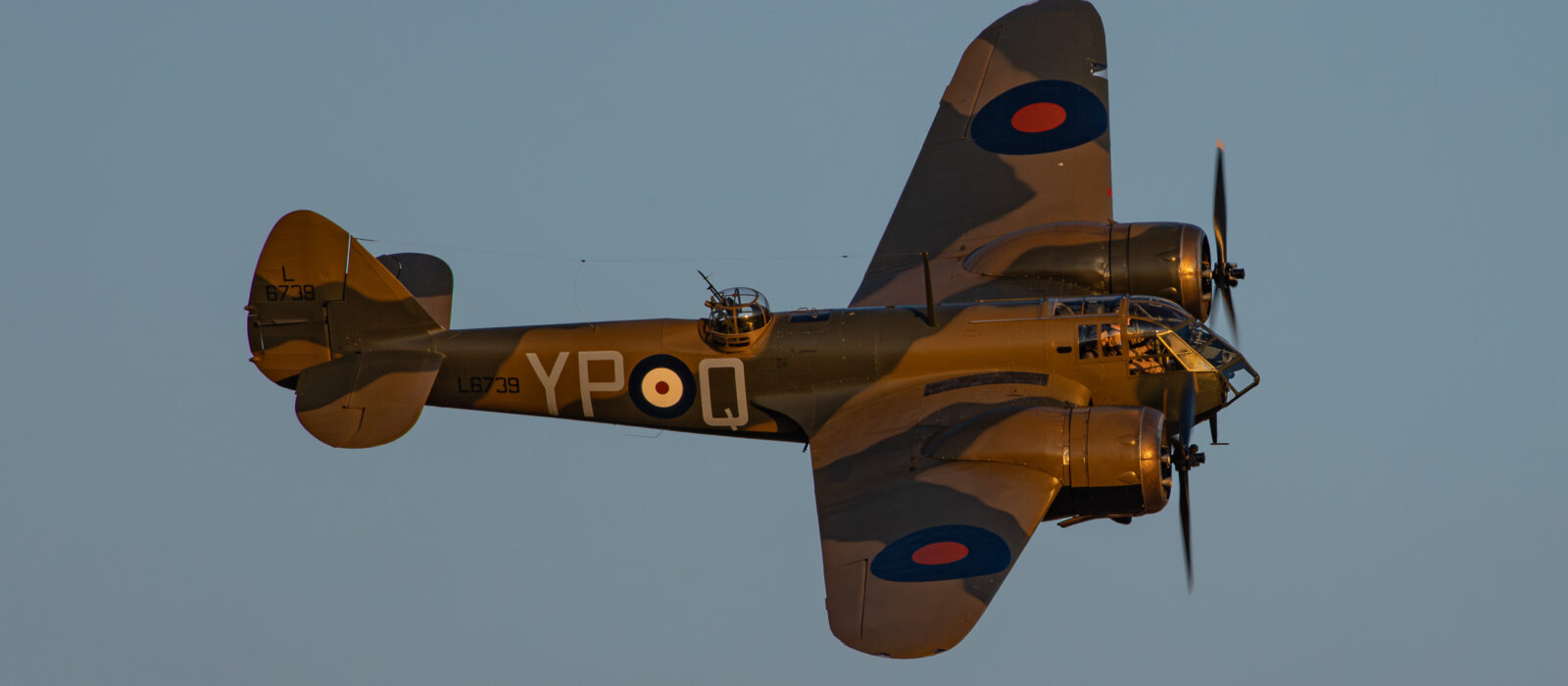
Elegant, fast and at the forefront of British aviation design when it first appeared, the Bristol Blenheim Mk IF L6739 represents a fascinating chapter in the Royal Air Force’s early wartime history. Today, registered as G-BPIV, it is the world’s only flying example of the Blenheim, a remarkable survivor that brings to life the aircraft and crews who fought in the dangerous opening months of the Second World War.
The Blenheim began life as the Bristol Type 142, a sleek civilian aircraft commissioned by newspaper proprietor Lord Rothermere. When the prototype first flew in 1935, its speed was so impressive that it reportedly outperformed the RAF’s contemporary fighters. The Air Ministry quickly recognised its potential and ordered a military version, which became the Blenheim Mk I. With an all-metal structure, retractable landing gear and twin Bristol Mercury radial engines, it represented a significant step forward in British aircraft design.
By the outbreak of war in September 1939, the Blenheim had become one of the RAF’s principal light bombers. However, the rapid development of fighter aircraft meant that it was increasingly vulnerable during daylight operations. Some Blenheims were therefore adapted for night-fighter duties, receiving additional machine guns and equipment to intercept enemy aircraft under cover of darkness. The Mk IF was one such variant, and it was in this role that L6739 began its operational career.
L6739 entered RAF service on 2 September 1939, just one day after Germany invaded Poland. It was assigned to No. 23 Squadron RAF, which operated Blenheim night fighters during the Battle of Britain. Flying from bases including RAF Collyweston, the squadron undertook night patrols and interception missions as the Luftwaffe shifted towards bombing British targets after dark. These operations were often challenging: early Blenheim night fighters lacked the performance of later designs, and many crews relied on visual observation to find their targets in the darkness.
After approximately a year of service, L6739 was returned to the Bristol Aeroplane Company in late 1940 and struck off charge. Most of the aircraft was scrapped, but its nose section escaped destruction. In an extraordinary twist, Bristol employee Ralph Nelson acquired the nose after the war and converted it into an electric car, mounting it on an Austin 7 chassis. He drove the unusual vehicle for years before it was damaged by fire. Crucially, Nelson retained many of the original aircraft components, preserving a vital part of L6739’s identity for the future.
The story of the Blenheim that flies today is actually a remarkable composite restoration. The majority of its airframe comes from Canadian-built Bolingbroke Mk IVT 10201, a Blenheim derivative that served with the Royal Canadian Air Force during the war. After years of storage, its remains were acquired for restoration and eventually brought to Duxford. The project initially returned the aircraft to the air in 1993 as a longer-nosed Blenheim Mk IV. Following a landing accident in 2003, the restoration team decided to rebuild it as the earlier Mk I fighter, incorporating the surviving nose of L6739. After an enormous restoration effort, it flew again on 20 November 2014, wearing the markings of No. 23 Squadron and the code YP-Q.
The Blenheim’s contribution to the war was considerable, despite the challenges faced by its crews. In the early months of the conflict, Blenheims carried out bombing and reconnaissance missions over Germany and occupied Europe. As night fighters, they helped defend Britain against nocturnal raids and contributed to the early development of airborne interception techniques. The aircraft was eventually superseded in many roles by more advanced designs, including the de Havilland Mosquito, but its crews continued to fly dangerous missions in the meantime.
Powered by two Bristol Mercury radial engines, the Blenheim Mk I could reach speeds of around 260 mph, impressive for a light bomber of the mid-1930s but increasingly inadequate against modern fighters by 1940. Its sleek design, retractable undercarriage and stressed-skin construction made it a technological pioneer, yet the speed of wartime innovation quickly transformed it from a cutting-edge aircraft into a machine fighting to remain relevant.