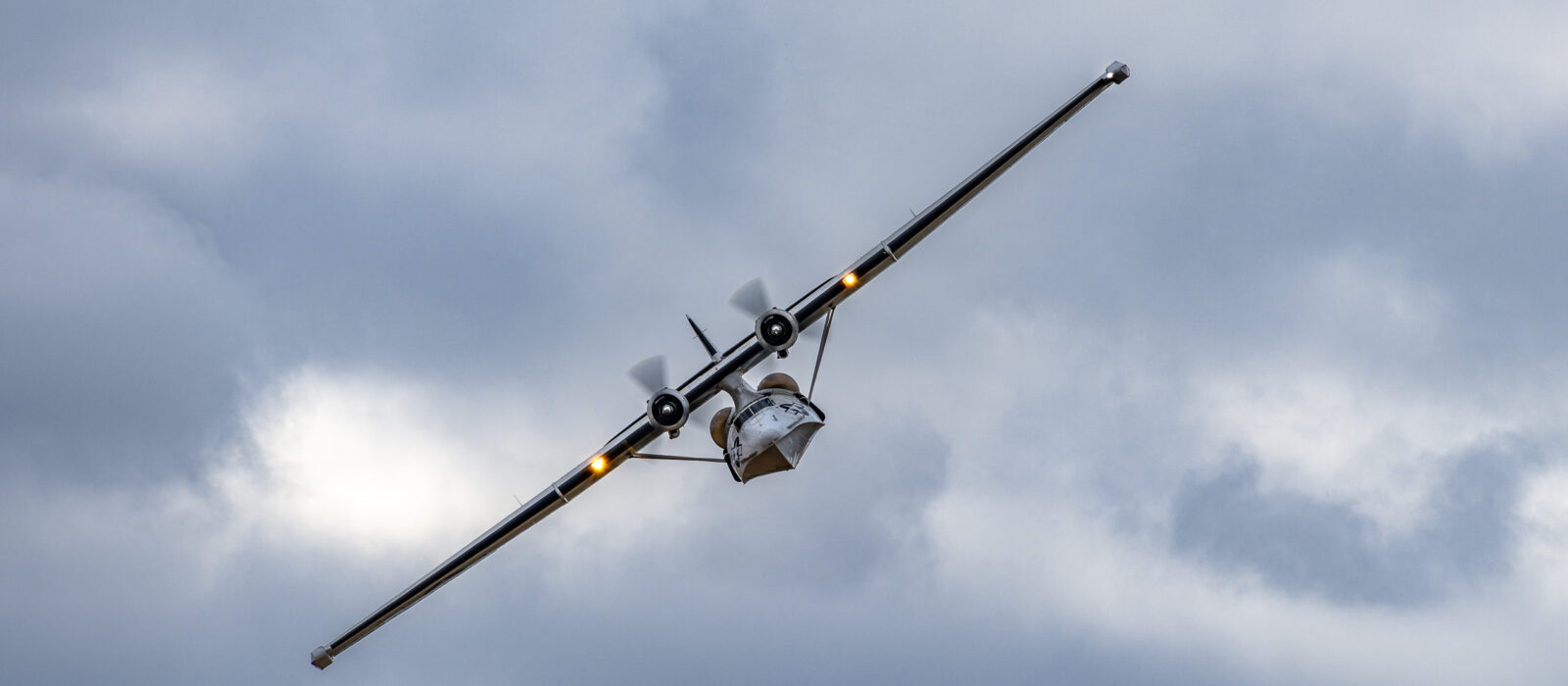
With its enormous parasol wing, distinctive hull and powerful twin radial engines, the Canadian Vickers Canso A G-PBYA is a magnificent survivor of the flying-boat era. Known today as “Miss Pick Up”, this amphibious aircraft belongs to the same family as the famous Consolidated PBY Catalina, one of the most versatile maritime aircraft of the Second World War. Designed to patrol vast stretches of ocean, hunt submarines and rescue aircrew lost at sea, the Catalina became a familiar sight wherever Allied forces needed to control the waterways.
Although commonly called a Catalina, G-PBYA was built in Canada by Canadian Vickers at Cartierville, Quebec, as a Canso A, the Canadian designation for the amphibious PBY-5A. Its construction number is CV-283, and it entered Royal Canadian Air Force service on 27 October 1943 with the serial 11005. The Canso’s retractable landing gear allowed it to operate from conventional runways as well as water, giving it far greater flexibility than a pure flying boat.
During the war, 11005 served with No. 9 (Bomber Reconnaissance) Squadron at Bella Bella on Canada’s Pacific coast before transferring to No. 7 (Bomber Reconnaissance) Squadron in the Queen Charlotte Islands, now known as Haida Gwaii. Its primary duties involved anti-submarine patrols, searching the coastal waters for enemy submarines and protecting Canada’s western approaches. Although the threat of a Japanese invasion of mainland Canada never materialised, the vast Pacific coastline demanded constant vigilance and long hours of maritime reconnaissance.
Following the end of the war, the aircraft remained useful in Canada’s expanding post-war aviation operations. It was converted for freight work in 1948 and later supported photographic reconnaissance, transport and search-and-rescue duties. It served with units including 413 Squadron and 121 Search and Rescue Flight before being struck off military charge on 25 May 1961. Its military career had ended, but the aircraft was about to embark on a remarkable second life in civilian aviation.
After leaving military service, the Canso began a long and varied civilian career. Initially converted for freight operations, it was later adapted as a water bomber, scooping up or carrying water to fight forest fires. It worked for commercial operators in Canada and also spent several fire-fighting seasons in France with the civil protection service, where it carried the call sign Pelican Bleu. In the 1970s and 1980s, it continued fighting fires for Norcanair and the Province of Saskatchewan, wearing vivid orange and yellow schemes that contrasted sharply with its wartime camouflage.
By the late 1990s, the aircraft had been retired from fire-fighting work and stored on Vancouver Island. It was eventually acquired by Plane Sailing, which undertook extensive work to prepare it for a new role carrying passengers and appearing at airshows. The water-bombing equipment was removed, a passenger interior was installed, and viewing blisters were added to the rear fuselage. After a lengthy preparation, the aircraft departed Canada in March 2004 and made an epic ferry flight across North America and the Atlantic, arriving in Britain at the end of that month. It was registered G-PBYA on 19 November 2004.
The aircraft’s current appearance is particularly distinctive. It represents OA-10A Catalina 44-33915, associated with the USAAF’s 5th Emergency Rescue Squadron of the Eighth Air Force, based at Halesworth in Suffolk. This rescue-themed identity recalls the vital work undertaken by Allied air-sea rescue units, whose crews searched for airmen forced to ditch in the North Sea and surrounding waters. The name “Miss Pick Up” is an affectionate nod to that rescue role, rather than the aircraft’s original Canadian military identity.
The Catalina family was powered by two Pratt & Whitney radial engines and designed for endurance rather than speed. Its high-mounted wing, stabilising floats and boat-shaped hull made it capable of operating far from conventional airfields. In wartime, Catalinas and Cansos conducted anti-submarine patrols, maritime reconnaissance, convoy protection and rescue missions across the Atlantic and Pacific. Their ability to remain airborne for long periods made them invaluable in the enormous expanses of ocean where locating a submarine—or a downed airman—could be a matter of life and death.