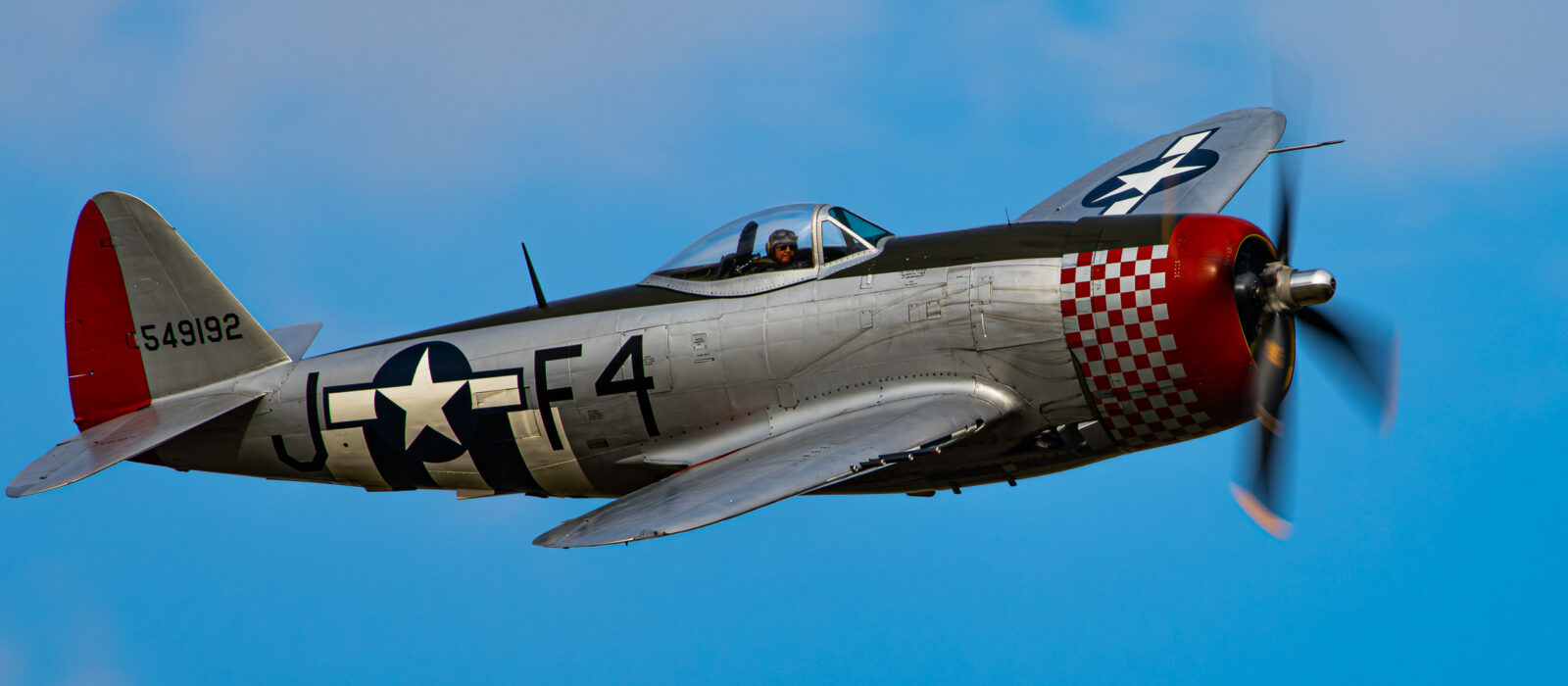
Few aircraft embody the sheer power and ruggedness of the Second World War fighter generation quite like the Republic P-47D Thunderbolt. Known affectionately as the “Jug” because of its bulky fuselage, the Thunderbolt was one of the largest single-seat fighters of the war. Yet beneath its substantial appearance lay an exceptionally capable aircraft, combining a powerful radial engine, heavy armament and remarkable ability to absorb battle damage. Today, G-THUN is a celebrated flying example of this American fighter, carrying the name “Nellie B” and the markings of the USAAF’s 492nd Fighter Squadron.
Built in 1945 at Republic Aviation’s Evansville factory in Indiana, this aircraft bears the original USAAF serial 45-49192 and construction number 399-55731. Designated a P-47D-40-RA, it arrived too late to make a significant contribution to combat operations in Europe during the Second World War. Instead, it served with the US Army Air Forces’ Air Training Command before being placed in storage at Tinker Field, Oklahoma. As the post-war military aviation landscape changed, the Thunderbolt would embark on a remarkable international journey.
In 1953, the aircraft was transferred to the Peruvian Air Force, joining a group of 25 Thunderbolts acquired from the United States for the nominal price of one dollar each. In Peru, it initially served as a frontline fighter before moving into the training role. It carried the Peruvian serial 119 and continued in service until 1967, after which it was stored in the open at Piura Air Base. For several years, the tropical climate threatened the survival of the ageing aircraft, but in 1969 a recovery effort led by aviation enthusiast and historian Ed Jurist brought it and other surviving Thunderbolts back to the United States.
The road to the airshow circuit was not straightforward. After returning to civilian ownership, the aircraft was involved in a serious landing accident at Tulsa, Oklahoma, in 1980. A major rebuilding project followed, involving replacement parts and extensive restoration work. The Fighter Collection acquired the project in 1984, and the aircraft finally returned to flight in August 1985 following reconstruction in California.
In January 1986, the Thunderbolt arrived at Duxford, England, where it became a familiar sight for British aviation enthusiasts. For many years, it appeared in the markings of the USAAF’s 78th Fighter Group as “No Guts, No Glory”, becoming closely associated with the Flying Legends airshows. In 2007, it returned to the United States, flying as N147PF, before making its way back to Britain in 2018. Its latest identity celebrates “Nellie B”, representing a P-47 of the 492nd Fighter Squadron, 48th Fighter Group, whose aircraft were distinguished by their red nose markings and checkerboard decoration.
Powered by the mighty Pratt & Whitney R-2800 Double Wasp radial engine, the P-47D was capable of speeds exceeding 430 mph, depending on the variant and conditions. Its eight .50-calibre Browning machine guns gave it formidable firepower, while its rugged construction made it particularly effective in the ground-attack role as the war progressed. Watching G-THUN in flight is a reminder that the Thunderbolt was far more than a large fighter: it was a versatile workhorse that helped establish Allied air superiority and supported ground forces across Europe.
From the American training fields to the skies of Peru, through a major rebuild and decades of airshow appearances, G-THUN has lived several lives. Its survival is a testament to the dedication of the restorers and operators who have kept this remarkable aircraft flying. With its unmistakable radial-engine roar and muscular silhouette, “Nellie B” remains a living tribute to one of the most powerful and distinctive fighters of the Second World War.