
Seeing lots of amazing aviation photos across Social Media and want to get involved? Or maybe you need some helpful tips and guidance on improving your shots. Over the next few weeks, we will go through the main aspects of aviation photography to help you fall in love with the Hobby and join the thousands of spotters and photographers across the world.
In this part, we are going to focus on the equipment you need, from starting off and then progressing through into more professional gear.
Camera Jargon
There are so many camera bodies and lens options now out of the new and second hand market, it can be difficult to work out what to purchase. Some people will say you need to spend thousands of pounds to get the best equipment, however, we do not believe this is the case. A good camera setup and a good eye can work just as much wonders as an expensive one.
| Jargon | Definition | What we recommend |
| FPS | Frames per second, the amount of pictures the camera will take when you hold the shutter button down. | Anywhere between 4 and 10 is plenty. |
| ISO | An old film camera term regarding the brightness of the film. In modern cameras this can be defined as digital brightness. | A range of 100 to 6400 should be plenty for day time aviation photography. |
| Autofocus | the automatic focusing feature built into the camera. Can be set to One time or Servo/Continuous. | Servo/Continuous Auto Focus is recommended |
| IBIS | In-Body Image Stabilisation. A mechanic built into your camera to help stabilise the sensor as you move taking photos. | This is a nice to have and not a must have. |
| IS | Image Stabilsation – a mechanic built into the lens to help keep the sensor steady while taking photos. | This is a nice to have and not a must have. |
| Subject Tracking | A camera feature that can help track the subject within yout viewfinder | This is a nice to have and not a must have. |
| Mirrorless | The new format of digital cameras where the camera digitally shows you the image through the lens in the viewfinder and not via a reflection on a mirror. | Less moving parts than a DSLR camera but can suffer from rolling shutter effects caused by how the data is read from the sensor. Has much faster Frames per Second capture times. |
| DSLR | Digital Single-Lens Reflex camera is a digital camera that uses an internal mirror and optical viewfinder system to let you look directly through the camera’s lens | Easier to use, however, the viewfinder is optical, so in comparison to the viewfinder on a mirrorless camera where what you see is what you will take settings wise, DSLRs will show you what the lens can see before taking into account the settings you have set. |
| Full Frame | A 35mm wide sensor that offers no crop factor, and good low light performance | Generally heavier cameras but offer better colour and low light performance. No recommendations here, this is a personal preference. |
| APS-C | A midsized sensor at only 23mm wide. Because of this you get a 1.5 to 1.6 times crop factor when using full frame lens. This makes your subject appear more zoomed in. | Lighter built cameras and generally a lot cheaper as well. The 1.6 x crop factor can be incrediblt useful for aviation photographers. No recommendations here, this is a personal preference. |
| Shutter Speed | The time it takes for the shutter to close and complete taking the photo. | Generally most camera will have a fast shutter speed of 1/2500th of a second all the way down to taking 30 seconds to close for long exposure shots in the dark. |
| Aperture | In optics and photography, it refers to the adjustable opening in a lens—formed by a diaphragm of blades. Measured in f stops of light, the lower the number the more light can hit the sensor. | Anything from f/4 to f/8 as the widest aperture will be more than enough. Most day time shots will use an aperture around f/5.6 or f/6.5 |
So what camera body should you go for? You will see this question alot acrosss forums and Facebook groups.
You should first ask yourself the following questions:
What is your budget?
How much do you initially have to spend to buy a camera body and a couple of lens options?
New or Second Hand?
Some people like buying new and others don’t mind the second hand market. MPB can be a great place to compare cameras and check used pricing.
Where and what will you be photographing?
This will help you decide if you need a camera with a fast frame rate for fast jets whizzing past you. Or maybe you only like taking static shots where you will be taking one photos at a time but will benefit from a full frame over an APS-C Sensor.
This will also help you decide on what lens you may which to purchase, as you can get the best focal length lens for what you need.
- 24-105mm – Static and low light.
- 70–200mm: Close aircraft and static displays.
- 100–400mm: General airshow photography.
- 150–600mm: Distant aircraft and fast jets.
Most of these will offer apertures between f/2.8 up to f/8. Keep in mind though the wider the aperture will be more expensive than something in the middle, so if you are under a tight buget to start with, look for a f/5.6 or f/6.5 lens in your desired focal length.
I will also mention Prime lenses here. These are lenses that are set to one focal length and don’t allow you to zoom our or zoom in. These as you expect have advantages an disadvantages, such as having a wider aperture for similar price points but can require you to stand further back if you want to capture something close by. They can be incredibly useful but do lack the versatility.
Lens Jargon
I think it will also be useful to decrypt the different parts of Lens names you will come across with a couple of examples.
Canon EF 400mm f/5.6L USM
| Jargon | What it Means |
| Canon | Manufacture |
| EF | This is the Lens mount. Different cameras makes have their own lens mounts that are only compatible with certain lenses. Mirrorless cameras have their own type of lens mounts as well. Some offer lens mounts to help adapt older lenses to newer cameras, so have a good read up on both Camera body and Lens before making the purchase. |
| 400mm | This is the focal length. This example is a Prime lens and doesn’t zoom in and out. |
| f/5.6L | This as a wider aperture of f/5.6 and L denotes it is Canon top quality lens glass in use. |
| USM | This stands for Ultra Sonic Motor and is the motor used to drive the autofocus. |
Canon RF 100-500mm f/4.5-7.1L IS USM
| Jargon | What it Means |
| Canon | Manufacturer |
| RF | Mirrorless Camera Lens Mount |
| 100-500mm | Focal range |
| f/4.5 – 7.1L | Aperture range. f/4.5 will be at 100mm and f/7.1 at 500mm when zoomed in. |
| IS | This Lens has image stabilisation |
| USM | Ultra Sonic Motor for the focusing. |
Accessories
Once you have settled on the camera and lens you think will be best for you, you will then need some accessories. Here are the basics we recommend to get over time, starting with the most important.
- Fast SD or CFexpress memory cards.
- Spare batteries.
- Lens cleaning cloth.
- Comfortable camera strap.
- Weather protection.
- Comfortable camera bag.
- Tripod
A good SD or CF Express card will do you good. Don’t just go for one with lots of space either. A 128GB SD card can hold a few thousand photos, but you need to balance this with a card with a good writeback speed. This means you won’t get hit by the cameras buffer running out of space (small internal storage, bit like a short term memory) as it is trying to write each photos to the SD Card (Long term memory). Do some reading up, or wait for a later part of this guide
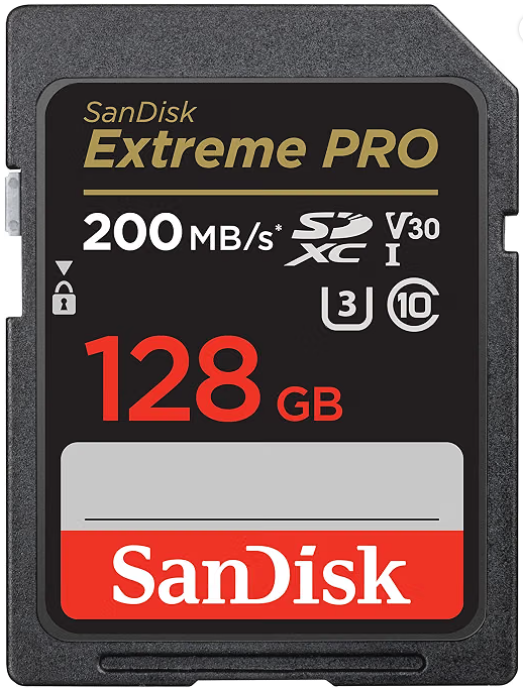
The price of cards has come down significantly over time, but as you can see here, this is a 128GB SanDisk SD card with a 200 MB/S write speed. I would recommend this type of card to start with and it should serve you well for a years. Always handy having a couple of you at all times.
We hope you have found part one of this guide useful. Next we will be going on to talk about. Camera settings.