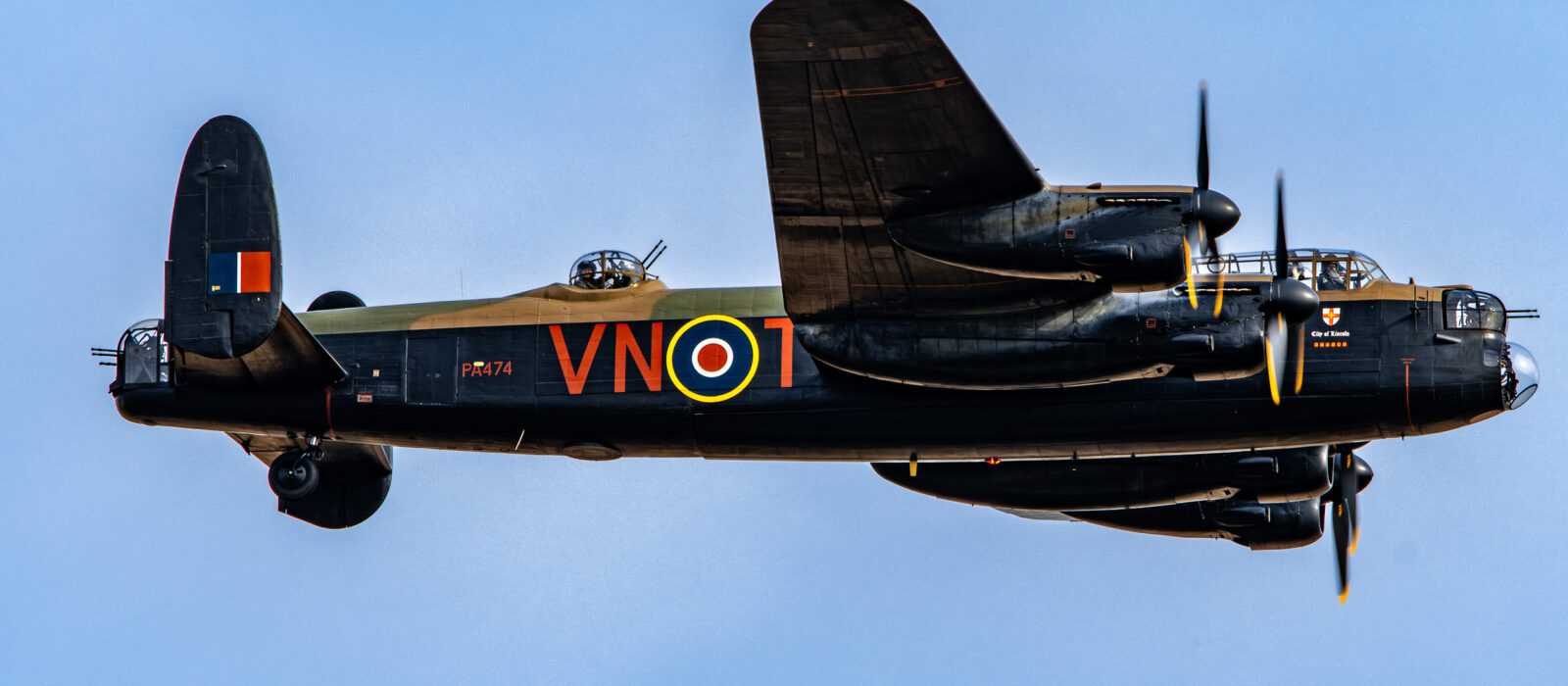
The sight of an Avro Lancaster in flight is one of the most evocative spectacles in British aviation. With its long, dark fuselage, distinctive twin tail and four Rolls-Royce Merlin engines, the Lancaster represents the courage and sacrifice of RAF Bomber Command during the Second World War. PA474, the celebrated Lancaster of the Royal Air Force Battle of Britain Memorial Flight (BBMF), is one of only two Lancasters remaining airworthy anywhere in the world. More than a historic aircraft, she is a flying tribute to the thousands of aircrew who served in Bomber Command.
PA474 was built at the Vickers-Armstrongs factory at Broughton, near Chester, and rolled off the production line on 31 May 1945, shortly after Victory in Europe Day. Intended for the RAF’s planned Tiger Force, which was to join the war against Japan in the Far East, she was completed too late to see combat before Japan surrendered in August 1945. Unlike many Lancasters, PA474 never flew a wartime bombing mission, but her subsequent career would prove remarkably varied.
After a period in storage, PA474 returned to service in 1948 with No. 82 Squadron, converted for photographic reconnaissance. With her gun turrets removed and specialised cameras installed, she undertook aerial survey work in East and South Africa. The photographs gathered on these missions helped produce maps of vast areas, some of which continued to be used long after the aircraft had returned to Britain. Her next role was experimental: in the early 1950s, she was involved in research into air-to-air refuelling before moving to the College of Aeronautics at Cranfield, where she supported aerodynamic research into laminar flow and boundary-layer control.
By the mid-1960s, PA474’s working life appeared to be drawing to a close. Instead, she was given a remarkable second chance. In 1965, the RAF’s 44 Squadron helped secure her for restoration to a wartime Lancaster configuration. After extensive work at RAF Waddington, she flew again on 7 November 1967. Her appearances at air displays soon made her a favourite with the public, and in November 1973 she joined the Battle of Britain Memorial Flight. She later became known as “The City of Lincoln”, a name that links the aircraft to the county that has long been associated with RAF Bomber Command and its wartime airfields.
The Lancaster was designed to carry a heavy bomb load over long distances, with four powerful Merlin engines and a large internal bomb bay. It became the RAF’s principal heavy bomber during the later years of the war, carrying out raids against industrial targets, transport networks and military installations across occupied Europe and Germany. Lancasters also undertook specialised operations, including the famous attacks on the German dams in May 1943 and the use of enormous earthquake bombs against heavily protected targets. Behind the aircraft’s impressive engineering, however, lay a devastating human cost: Bomber Command suffered enormous losses, and many aircrew never returned from their missions.
Today, PA474 is maintained by the RAF Battle of Britain Memorial Flight at RAF Coningsby in Lincolnshire. The BBMF’s mission is to keep historic RAF aircraft airworthy so that they can commemorate those who served and inspire future generations. Her appearances at commemorations, flypasts and airshows allow audiences to experience the unmistakable sound and presence of a wartime Lancaster. The aircraft is not simply a reminder of technical achievement, but a memorial to the aircrew whose stories deserve to be remembered.
PA474 reached her 80th birthday in May 2025. Later that year, she entered an extensive maintenance programme at the Aircraft Restoration Company at Duxford, with the work scheduled to continue into 2027. The RAF announced that she would emerge in markings representing Lancaster LM220 of No. 9 Squadron, including the famous nose-art slogan “Getting Younger Every Day”. While she is away from the display circuit during this work, the aim is to preserve her for future generations. When PA474 eventually returns to the skies, the deep growl of her four Merlins will once again evoke the era of the RAF’s wartime heavy bombers — and honour the people behind the history.