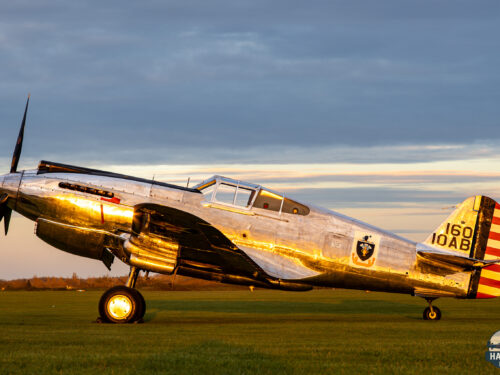
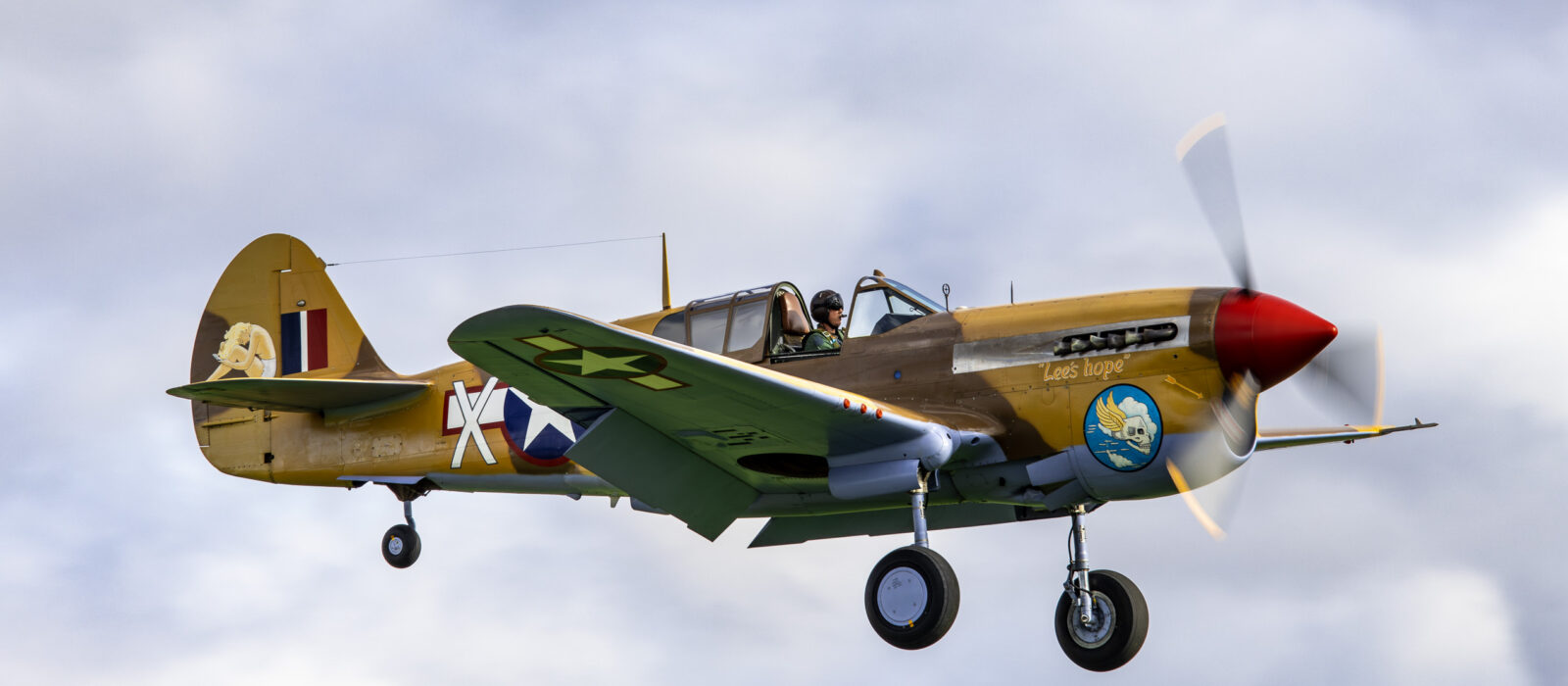
With its aggressive profile, shark-like nose and powerful Merlin engine, the Curtiss P-40F Warhawk G-CGZP is a striking survivor of the American fighter force of the Second World War. The P-40 became one of the most recognisable Allied aircraft of the conflict, serving across Europe, North Africa and the Pacific. Although it was often outclassed by newer fighters at high altitude, the Warhawk proved rugged, dependable and highly effective in the hands of skilled pilots. G-CGZP is especially unusual: a rare Merlin-powered P-40F that has survived decades of abandonment, recovery and painstaking restoration.
The aircraft was manufactured by Curtiss at Buffalo, New York, in 1942, originally carrying the US Army Air Forces serial 41-19841 and construction number 19503. It was shipped to the Pacific theatre late that year, arriving with the USAAF’s Thirteenth Air Force in the South-West Pacific on Christmas Eve 1942. Its precise wartime service history remains incomplete, but the aircraft was eventually abandoned on the island of Espiritu Santo in the New Hebrides, now part of Vanuatu. There it remained for decades, exposed to the elements as the jungle gradually reclaimed the airframe.
The P-40F represented an important development of the Warhawk design. Earlier P-40s used the Allison V-1710 engine, which offered good performance at lower altitudes but struggled to maintain power higher up. The F model introduced the Packard-built Rolls-Royce Merlin V-1650 engine, giving the fighter improved high-altitude performance. Unlike the familiar Allison-powered versions, the Merlin-powered P-40F lacked the prominent carburettor intake on top of the nose, giving it a smoother, more streamlined appearance. Later production aircraft also received a lengthened fuselage to improve directional stability.
The Warhawk’s journey back to the air began after its wreckage was recovered from Espiritu Santo in the 1970s. The remains were acquired by The Fighter Collection at Duxford, and the restoration was entrusted to specialists in Australia. The airframe was rebuilt at Wangaratta by Precision Aerospace, where extensive work transformed the long-abandoned wreck into an airworthy aircraft. After its first flight in Australia in 2011, the restored fighter was shipped to Britain and joined The Fighter Collection at Duxford, where it became a rare sight on the European warbird circuit.
Today, G-CGZP wears the markings of “Lee’s Hope”, representing a P-40F associated with Lieutenant Robert J. Duffield of the 85th Fighter Squadron, 79th Fighter Group, operating from Capodichino airfield in southern Italy in early 1944. The 79th Fighter Group fought throughout the Mediterranean theatre, supporting Allied operations in North Africa, Sicily and Italy. Its fighters undertook escort, interception and ground-attack missions in a demanding campaign fought over rugged terrain and heavily defended targets. The aircraft’s markings pay tribute to the men who flew the Warhawk during this later phase of the war.
Powered by a Rolls-Royce Merlin 500 engine, G-CGZP delivers the distinctive sound and performance associated with one of the most famous engine designs in aviation history. The P-40F was armed with six .50-calibre Browning machine guns, and could also carry bombs for ground-attack missions. Its rugged construction and responsive handling made it a valuable combat aircraft, particularly at low and medium altitudes, where its durability and ability to absorb damage could be decisive.
The P-40’s reputation is often associated with the shark-mouthed fighters of the American Volunteer Group, the legendary “Flying Tigers”, but the Warhawk’s service extended far beyond China and Burma. It equipped Allied air forces around the world and helped sustain the fight during the early years of the war, when more advanced aircraft were not yet available in sufficient numbers. The type’s continued use in combat demonstrated that sound tactics, determined pilots and a robust design could overcome many technical disadvantages.
G-CGZP is a remarkable example of that enduring legacy. From its wartime dispatch to the Pacific and abandonment on a remote island to its recovery, restoration in Australia and return to the skies over Britain, its story is one of survival against the odds. As “Lee’s Hope” powers past with its Merlin engine roaring, it offers a vivid connection to the fighter pilots who flew the P-40 in the Mediterranean and to the restorers who ensured that this rare variant would fly again.