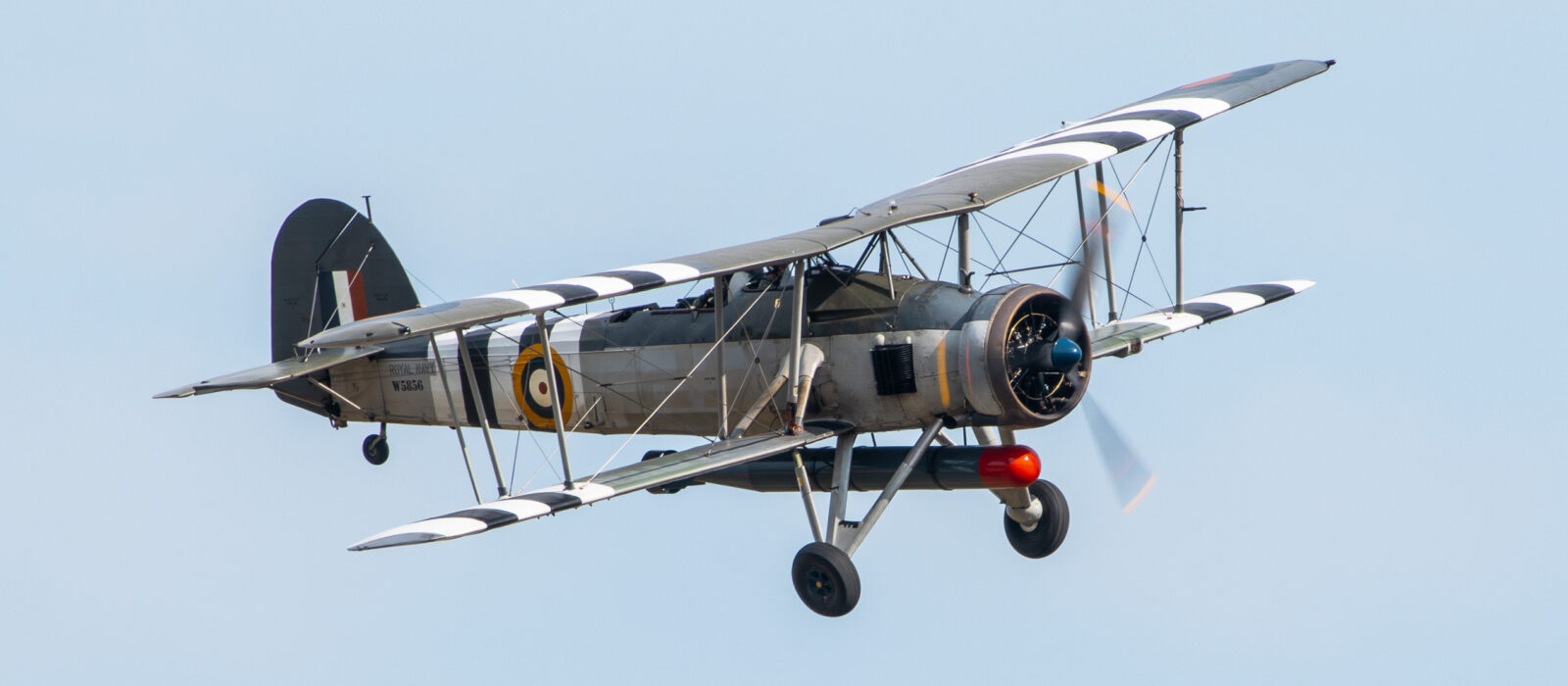
Few aircraft demonstrate the courage and ingenuity of the Fleet Air Arm quite like the Fairey Swordfish. Nicknamed the “Stringbag” because of its ability to carry an extraordinary variety of weapons and equipment, this fabric-covered biplane became one of the Royal Navy’s most successful naval strike aircraft of the Second World War. The Swordfish may have looked outdated beside sleek monoplane fighters, but its rugged construction, slow-speed handling and remarkable ability to operate from aircraft carriers made it a formidable weapon at sea.
W5856 is one of the most historically significant Swordfish survivors in the world, and the oldest airworthy example. Built by Blackburn Aircraft at Sherburn-in-Elmet in Yorkshire, it belonged to a batch of Swordfish produced by Blackburn rather than the original designer, Fairey Aviation. These aircraft were sometimes known as “Blackfish”. W5856 first flew on 21 October 1941, Trafalgar Day, a fitting date for an aircraft destined to become a lasting symbol of British naval aviation.
Following delivery to the RAF’s 82 Maintenance Unit at Lichfield, W5856 was prepared for overseas service and sent to Gibraltar. It served with the Royal Navy’s Mediterranean Fleet for approximately a year, probably undertaking patrol duties around the strategically important waters near Gibraltar. Although the precise details of its wartime sorties are not fully documented, the aircraft served during a critical period when Allied shipping and naval forces faced constant threats from Axis aircraft, submarines and surface vessels.
During the winter of 1942–43, W5856 returned to Fairey’s Stockport factory for refurbishment. It subsequently moved into advanced flying training and trials work before being transferred to the Royal Canadian Navy in 1944. There, it continued in a training role before being placed in reserve after the war. Its survival was far from guaranteed: after disposal, the aircraft passed through civilian hands, and one reported plan was to convert it into a crop-spraying machine.
The Swordfish’s fortunes changed in 1977, when aviation enthusiast Sir William Roberts acquired it for his Strathallan Collection in Scotland. W5856 arrived in crates in August, in a badly corroded condition. In 1990, British Aerospace purchased the aircraft and undertook an extensive restoration to flying condition. After a successful test flight at Brough in May 1993, it was presented to the Royal Navy Historic Flight. Three years later, it was adopted by the City of Leeds, recognising the contribution of local companies to Swordfish production during the war.
A further challenge arose in 2003, when corrosion in the wing structure forced W5856 to be grounded. Its future looked uncertain until BAE Systems stepped in to construct a new set of wings, delivered in 2012. Supported by major heritage funding from the Peter Harrison Heritage Foundation, the aircraft was restored to full flying condition and returned to the display circuit in 2015.
W5856’s familiar finish represents a Swordfish of 820 Naval Air Squadron during the 1941 attack on the German battleship Bismarck. The Swordfish played a pivotal role in that operation: on 26 May 1941, aircraft from HMS Ark Royal attacked Bismarck, and a torpedo strike damaged the battleship’s steering gear, helping British naval forces catch and destroy it the following day. The aircraft’s contribution to this operation became one of the most celebrated episodes in Fleet Air Arm history.
The Swordfish was powered by a Bristol Pegasus radial engine and had a top speed of around 140 mph, depending on load and configuration. Its typical armament included a forward-firing machine gun, a rear defensive gun and the ability to carry a torpedo, bombs or mines. It also served in the Battle of the Atlantic, protecting convoys and operating from escort carriers, and took part in the daring raid against the Italian fleet at Taranto in November 1940.
Today, W5856 is operated by Navy Wings, continuing the work of the former Royal Navy Historic Flight as a flying memorial to Britain’s naval aviators and engineers. Its survival is extraordinary: from wartime Mediterranean patrols and Canadian training duties to decades of storage, corrosion, restoration and renewed flight, it has repeatedly escaped the fate that befell so many of its contemporaries.
When W5856 takes to the skies, its open cockpit, fabric-covered wings and unmistakable biplane silhouette offer a vivid connection to an era when courage and determination could matter as much as speed. The “Stringbag” may have been considered obsolete when war broke out, but its remarkable record proved that a well-designed aircraft, flown by skilled crews, could change the course of naval history.