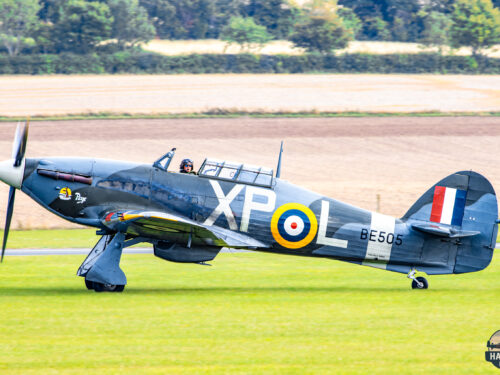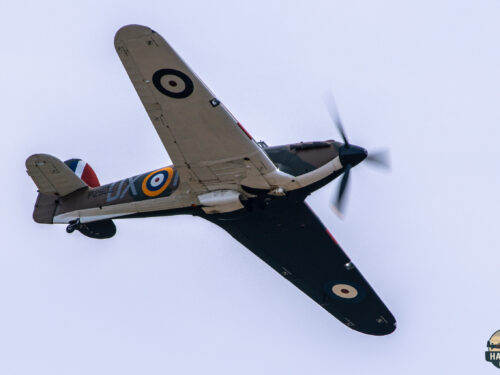
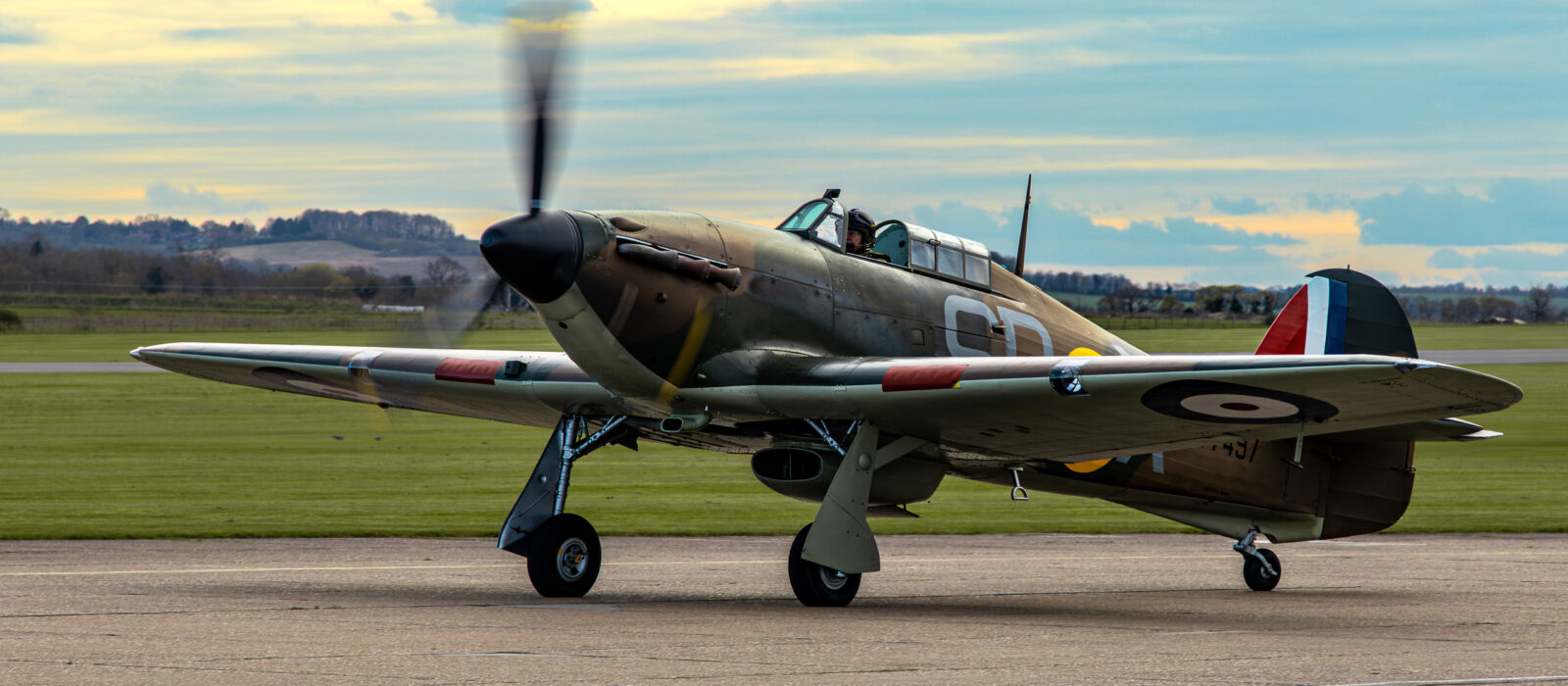
The Hawker Hurricane Mk I V7497 is a remarkable survivor of the Battle of Britain, a fighter whose original combat career lasted just a few days before it was lost in action over Kent. Recovered from the ground decades later and painstakingly rebuilt, this historic aircraft returned to the skies in 2018. Today, registered as G-HRLI, it flies in the markings of No. 501 (County of Gloucester) Squadron, carrying the code SD-X and preserving the memory of the RAF pilots who defended Britain in the summer and autumn of 1940.
Built by Hawker Aircraft at Kingston in August 1940, V7497 was powered by a Rolls-Royce Merlin III engine. It was delivered to No. 20 Maintenance Unit at RAF Aston Down before being issued to No. 501 Squadron at RAF Kenley on 19 September 1940. The squadron had already experienced intense fighting over France and Britain and was heavily involved in the defence of south-east England during the Battle of Britain.
V7497 first flew operationally on 24 September 1940, when Sergeant Cyril Sayward took it on a patrol. Over the following days, the aircraft flew further sorties as the Luftwaffe continued its attacks against RAF airfields and targets across southern England. Its operational life was tragically short: on the morning of 28 September 1940, V7497 was engaged by German Messerschmitt Bf 109 fighters during an interception over Kent.
The Hurricane was flown that day by Pilot Officer Everett Bryan Rogers, who had joined No. 501 Squadron earlier that month. During the engagement, his aircraft was shot down and crashed near East Sutton, close to Maidstone. Rogers escaped by parachute and survived. He went on to serve during the war, later flying with Bomber Command and receiving recognition for his service. V7497, however, remained buried at its crash site, its story largely forgotten beneath the Kent countryside.
Decades later, an aviation archaeology excavation recovered significant parts of the wreckage, including identity plates that helped confirm the aircraft’s identity. Hawker Restorations undertook an extensive reconstruction, using the recovered material as the foundation for an airworthy rebuild. The project included the restoration of an original Merlin III engine, bringing the sound and character of an early-war Hurricane back to life.
On 30 August 2018, V7497 made its first post-restoration flight at Elmsett in Suffolk. It was subsequently delivered to the Imperial War Museum at Duxford, where it became part of the living history of the Battle of Britain. Its return to flight was especially meaningful: the aircraft had survived neither intact nor untouched, but enough of its original identity remained to reconnect it directly with the events of September 1940.
The Hurricane Mk I was a central part of Britain’s air defence during the Battle of Britain. Though often overshadowed in popular memory by the Spitfire, the Hurricane accounted for a substantial proportion of RAF fighter victories during the campaign. Its robust construction, stable handling and eight Browning .303 machine guns made it a formidable opponent, particularly against the Luftwaffe’s bombers.
When G-HRLI banks across the sky in its 501 Squadron colours, it offers a powerful reminder of the young pilots who went into combat with little warning and often against overwhelming odds. V7497’s story is one of loss, recovery and renewal: a fighter brought back from the ground to honour the men and women who helped defend Britain during one of its most critical hours.