 By DrSoda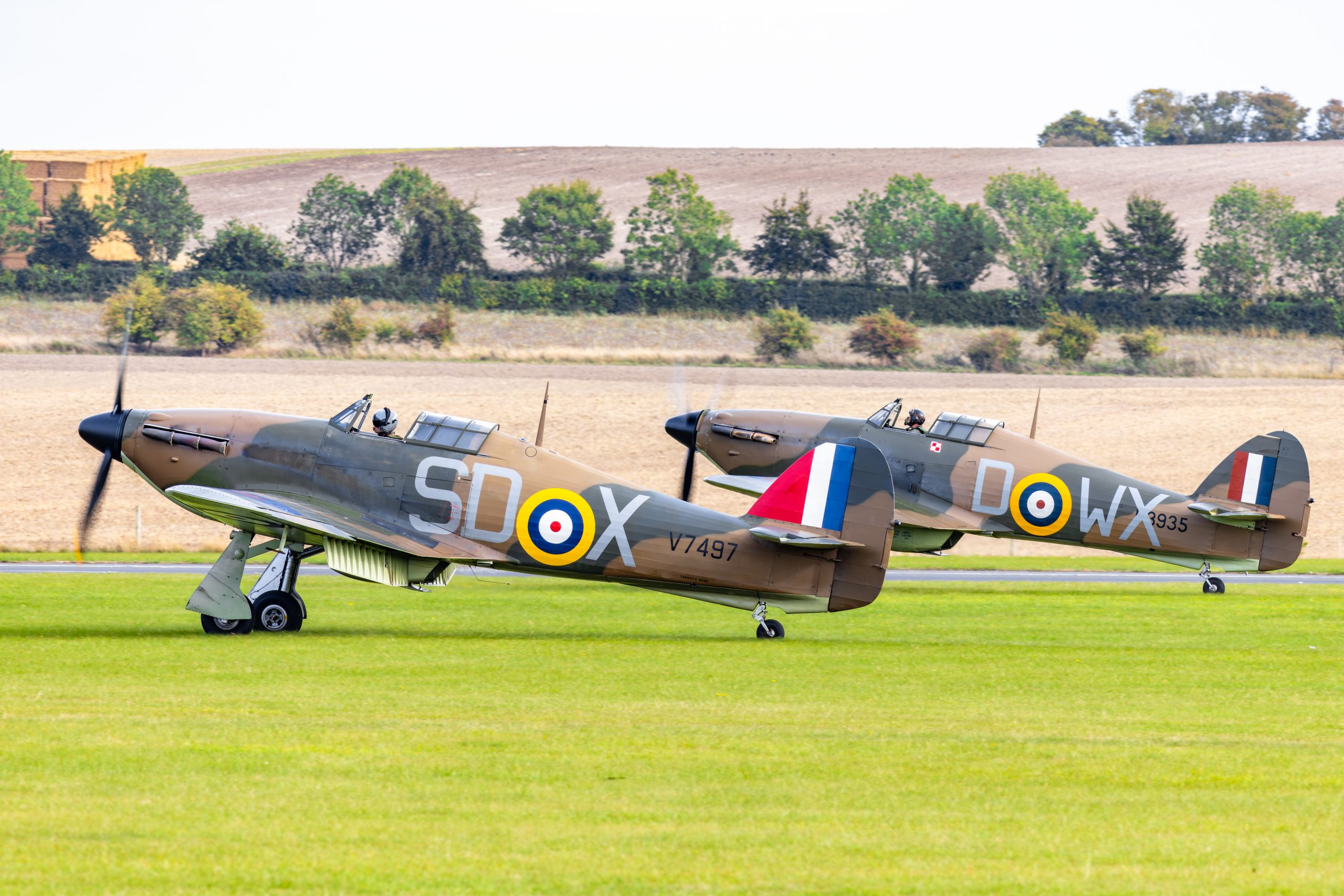
6th November 1935. Hawker Chief Test Pilot, Flight Lieutenant George Bulman, took the prototype K5083 into the air for the very first time. After 14,483 Hurricanes were built, 16 airworthy examples still grace the skies today.
The Hurricane was truly the backbone of the RAF during the early years of the war. Often overshadowed by the newer, faster, more agile Spitfire, the Hurricane claimed more aerial victories than the Spitfire throughout the Battle of Britain and proved how rugged and dependable the airframe was. So much so, badly damaged Hurricanes often managed to return to base, and due to the materials used and the simple design, they could easily be restored and pushed back out to defend their country once again.
Design Basis
Proposed as a monoplane derivative of the Hawker Fury biplane in the early 1930s, the Hurricane design team refined the concept and caught the attention of the Air Ministry with innovations that shifted their focus away from the outdated biplane design. Equipped with a more powerful engine, in this case the famous Rolls-Royce Merlin engine, and featuring retractable landing gear, the Hurricane paved the way for a new era of wartime fighter aircraft leading into the Second World War.
Entering production in June 1936 and joining RAF service in December 1937, the Hurricane comprised 18 squadrons by the outbreak of the war. It served across multiple theatres in many variants, not only for the RAF but also for the Royal Navy, Royal Canadian Air Force, and the Soviet Air Forces.
Variants
There were three marks of the Hawker Hurricane that entered service over its lifetime, starting with the Hurricane Mk I entering service in 1937 and the Mk IV towards the end of the war. A Mk V was developed but was scrapped after one prototype and two conversions were built, as it was realized the Hurricane had reached the peak of its wartime potential and was now obsolete.
Hurricane Mk I
Powered by the Rolls-Royce Merlin C engine and later the Merlin II, Mk Is were built incredibly quickly for the RAF and designed so that maintenance units could rapidly repair major battle damage and make the aircraft serviceable again. With fabric-covered wings and a wooden two-bladed fixed-pitch propeller, this was a Hurricane in its rawest and simplest form. Loved for its wide undercarriage configuration, giving it excellent on-ground handling during takeoff and especially landing, it suffered far fewer nose-over landing incidents than its Spitfire counterpart.
Due to its large thick wings, it provided a stable gun platform, accommodating eight .303 Browning machine guns in groups of four in each wing.
The Mk I evolved over its initial production run, and by the end of the Mk I’s days, it was powered by a Merlin III engine, had a constant-speed metal propeller, and ejector exhausts for added thrust. The wings had changed from their fabric-covered roots to stressed metal-covered wings, and an armored glass panel was installed at the front of the windscreen.
In 1940, Identification Friend or Foe (IFF) was fitted to the Hurricane, allowing the aircraft to be identified as friendly on British radar. Early Hurricanes can be identified by the aerial mast running from the cockpit to the tail section of the aircraft.
100-octane fuel became more available, allowing the Mk I’s Merlin III to generate more power, including increased Wartime Emergency Power (WEP) from 6 lbs to 12 lbs if required, without damaging the engine. WEP could be used in 5-minute bursts and had to be logged in the engine logbook if ever used. The additional power became a useful tool over Dunkirk when Hurricanes were tasked with assisting in Operation Dynamo.
Hurricane Mk II
There were 7 sub-variants of the Mk II that were produced and entered service.
Mk IIA
The Mk II added to the developments of the Mk I with the now present Merlin XX engine which featured a new two-speed supercharger offering more power at both low and high altitudes. To fit this, the engine bay in front of the cockpit was lengthened by 4 inches and a larger radiator was designed and fitted to allow the required cooling.
IIB
The IIB was fitted with additional .303 Browning machine guns compared to before. Now with 6 going into each wing for a total of 12. The first eight were fitted the same as they were on the Mk Is and the additional two were fitted outboard of the landing lights. A longer propeller spinner was also added.
IIB Trop
Same as the IIB before, but was used in the North African Theatre. Aircraft serving here were ‘tropicalised’ and dust filters were added to the engines. Pilots were also issued desert survival kits.
IIC
The Mk IIC was also upgunned, losing its twelve .303 Browning machine guns and now having two 20mm Hispano cannons in each wing, each requiring a small blister added into the wing to allow them to clear the breeches and feed motors.
Trials with the Mk IIC also began for it to carry 500 lbs bombs. These would conclude as successful and Hurribomber was born. This gave the Hurricane an extra role of being a ground-attack aircraft as well as a fighter. Mk IICs would also be used for night fighter and intruder sorties as well. The BBMF’s PZ865 was the last Hurricane to be built, and this was Mk IIC.
Mk IID & Mk IIE
The last two sub-variants of the Mk II were built around the ground attack/support role. With German tanks boasting more and more armour protection, it was becoming apparent the 20mm Hispano cannons were no longer cutting the mustard and were replaced on some aircraft by a 40mm cannon attached to each wing via a pod. They were joined by a single Browning .303 in each wing firing tracer rounds purely for aiming assistance. Each cannon could carry 15 rounds.
The Mk IIE progressed with this design but was fitted with wing racks.
Hurricane Mk III
The Mk III was intended to be fitted with Packard-built Merlin engines; however, by the time production had started, Rolls-Royce had boosted their output and this design was scrapped.
Hurricane Mk IV
The last and final major design change to the Hurricane before being phased out, the Mk IV had a new wing design rationalizing down to be able to mount a weapon configuration that was required. From pairs of 250 or 500 lbs bombs, two 40mm cannon, eight 60-pounder RP-3 rockets, additional drop tanks, or smoke curtain installations.
Extra armor plating was fitted around the radiator housing, fuel tanks, and cockpit to allow further survivability from its ground-attack missions over Europe. However, by the end of 1944 it was replaced in this role by her more modern sibling, the Hawker Typhoon.
Sea Hurricane
A purpose-built Hurricane was built for the Royal Navy. Most of these aircraft were converted from tired Mk I airframes that had done their time on the frontlines. However, a number were freshly built and developed over the years.
Modified to be carried by catapult-armed Merchantman (CAM) ships equipped with a catapult to launch single aircraft but had no way to recover them, unlike an aircraft carrier. If pilots were not near a land base when they hit bingo fuel, they would ditch and get picked up by a nearby ship.
Mk IB
Modified and equipped with catapult spools and an arrester hook, Mk IBs would begin operating from HMS Furious from late 1941. 300 Hurricanes were converted to this specification. Most were fitted with de Havilland propellers as they were lighter than the Rotol types which had a tendency to pull the nose down on landing and dunk the flight deck.
Mk IC
Now fitted with the 4-cannon wing, the IC also had its Merlin III engines adjusted to allow for 16 lbs of WEP instead of the standard 12.
Mk IIC
Finally catching up with the RAF Hurricane squadrons, the IIC was fitted with the Merlin XX engine allowing an increased top speed of 342 mph at 22,000 ft.
Legacy
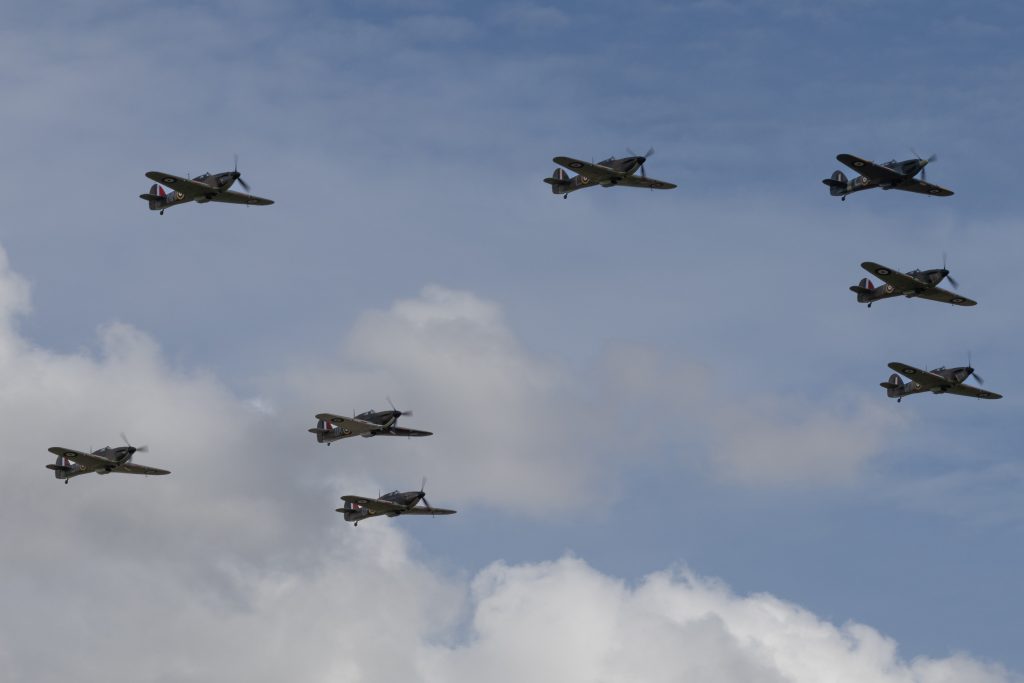
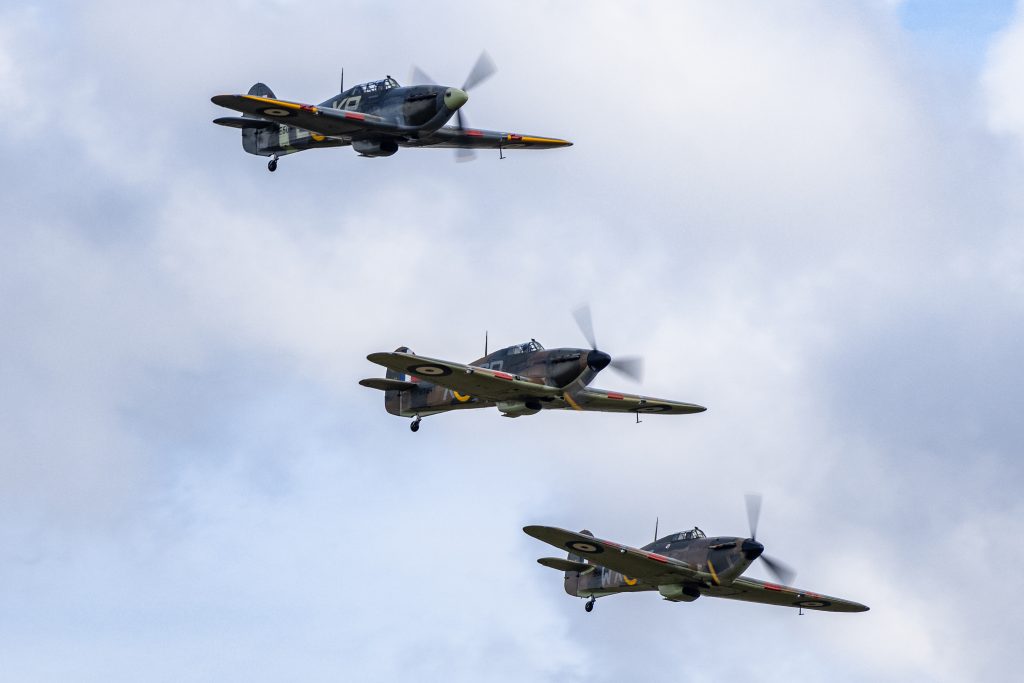
The Hawker Hurricane truly was a legend of the war, and it’s fantastic to still see them flying over the skies of the UK. Those lucky enough to attend the Battle of Britain Airshow this year (2025) at IWM Duxford were treated to the sight of eight of the remaining 16 airworthy Hurricanes in the sky, giving a real sense of what a squadron in flight would have looked like. It was the largest collection of Hurricanes flying in one place for quite some time, and the exciting prospect remains that in 10 years’ time, maybe, just maybe for the 100th anniversary, we could see that number reach double figures.