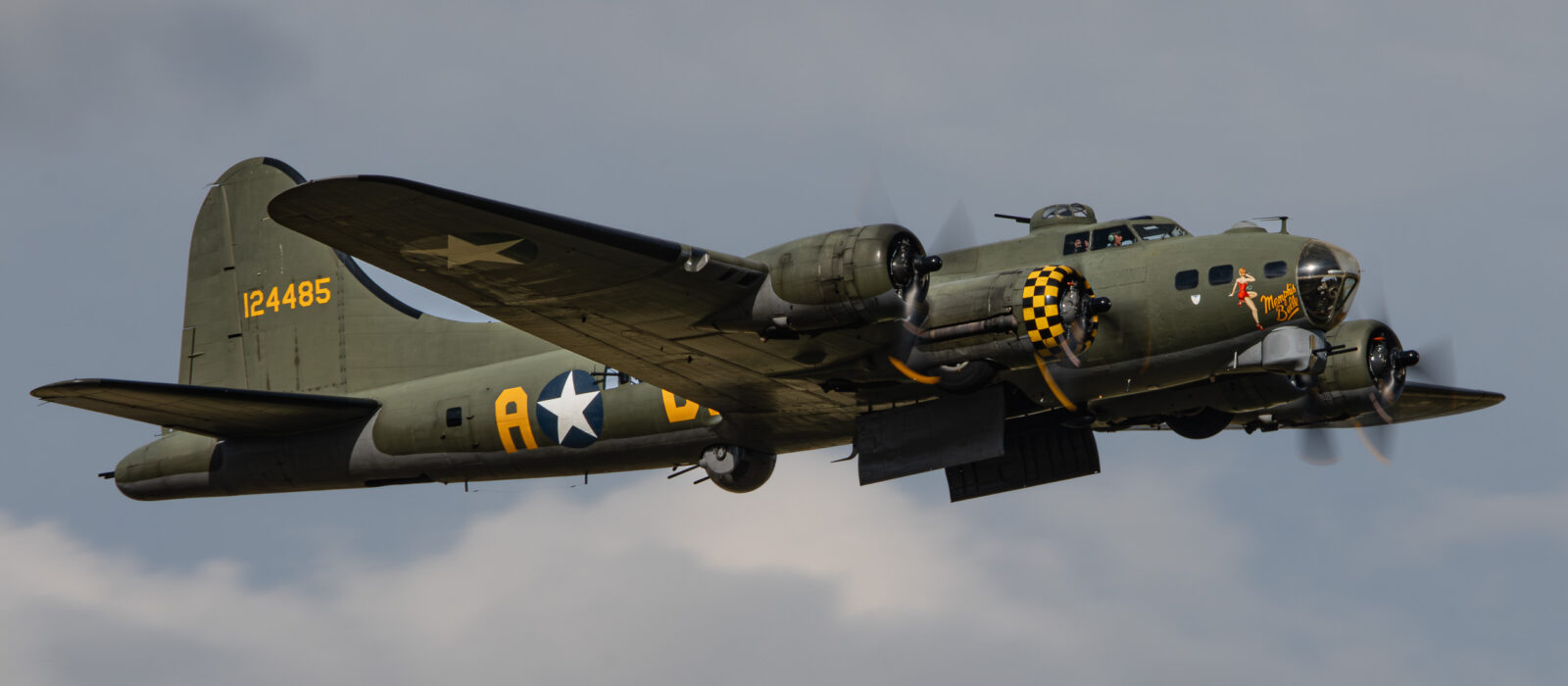
Few aircraft capture the scale, power and human cost of the air war over Europe as vividly as the Boeing B-17 Flying Fortress. With its four radial engines, broad wings and distinctive glazed nose, the B-17 became one of the most recognisable heavy bombers of the Second World War. Today, Sally B is a living link to the thousands of American airmen who flew dangerous daylight missions from bases across Britain — and one of the most treasured sights on the UK airshow circuit.
Sally B was built in 1945 at the Lockheed-Vega factory in Burbank, California, as B-17G-105-VE, USAAF serial 44-85784. Accepted by the United States Army Air Forces on 19 June 1945, she arrived too late to take part in the Second World War. Rather than being sent into combat, she entered a different chapter of aviation history, initially serving as a training aircraft before being converted for experimental work. During these trials, she was involved in research into infrared tracking equipment, including unusual modifications to her nose and wingtip installations.
In 1954, the aircraft passed to France’s Institut Géographique National, where she was registered F-BGSR and used for aerial survey and mapping. For the next two decades, the big bomber continued working over the French landscape, a very different mission from the perilous raids for which the B-17 had become famous. As the cost of operating the ageing fleet rose and replacement aircraft became available, the organisation began retiring its Fortresses.
In March 1975, British businessman and pilot Ted White brought the aircraft to the UK, where she was based at the Imperial War Museum Duxford. He named her Sally B, in honour of his companion Elly Sallingboe, who would become central to the aircraft’s long-term survival. Restored and maintained by a dedicated team, the Fortress became a regular presence at air displays and a flying memorial to the USAAF airmen who lost their lives in the European theatre. Since then, the aircraft’s continued operation has depended on specialist engineering, volunteer effort, donations and the support of aviation enthusiasts.
One of Sally B’s most famous appearances came during the making of the 1990 film Memphis Belle, which told the story of a B-17 crew completing 25 combat missions. Sally B was among the Fortresses used in the production and played a prominent role in the film’s dramatic closing sequence. Although she was not the original Memphis Belle, her participation helped bring the sights and sounds of wartime bomber operations to a new generation.
The B-17G was the final major production version of the Flying Fortress, featuring improved defensive armament, including a chin turret beneath the nose to strengthen protection against head-on fighter attacks. Powered by four Wright R-1820 Cyclone radial engines, the B-17 could carry a substantial bomb load over long distances while defending itself with multiple machine-gun positions. Its crews endured freezing temperatures, oxygen shortages, flak and fighter attacks in unpressurised aircraft, often on missions lasting many hours. The aircraft became a symbol of both American industrial power and the extraordinary risks faced by bomber crews.
Today, Sally B is operated by B-17 Preservation Ltd and remains based at Duxford, where she is on static display when not flying. She is widely recognised as the last remaining airworthy B-17 based in Europe. When those four engines start and the Fortress lifts into the sky, the sound is more than a spectacular airshow moment: it is a tribute to the men who flew these aircraft and to the people who have devoted decades to keeping this remarkable survivor alive.