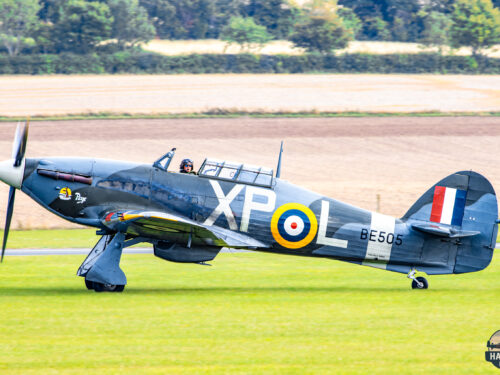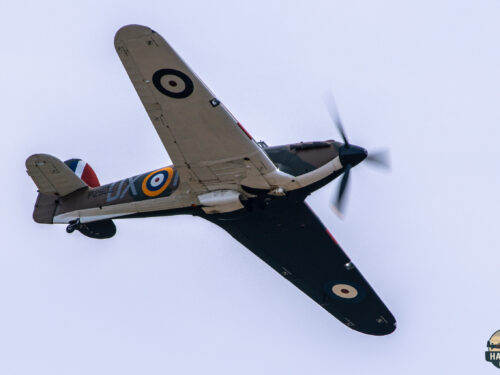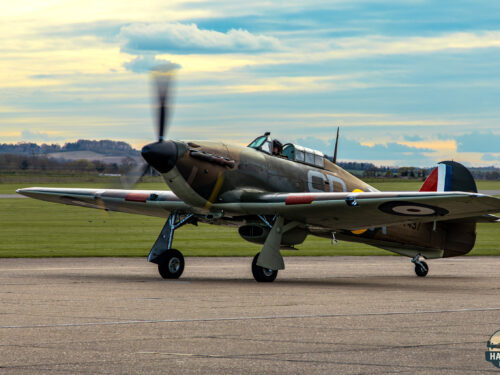
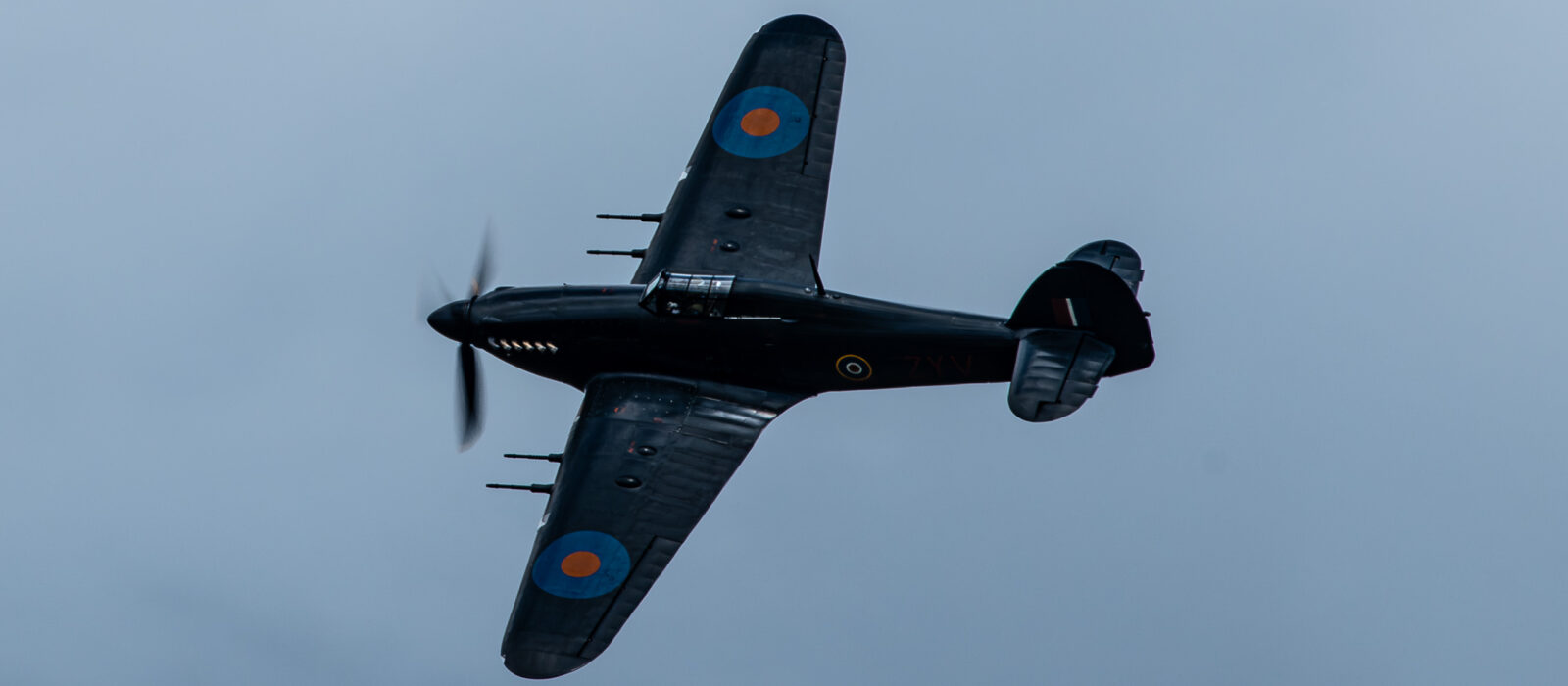
Few aircraft carry quite the historical significance of Hawker Hurricane Mk IIC PZ865, the final Hurricane to emerge from Hawker’s production line. Known affectionately as “The Last of the Many”, this remarkable aircraft represents the end of a production story that saw 14,533 Hurricanes built. Today, it flies with the Royal Air Force’s Battle of Britain Memorial Flight (BBMF), preserving the legacy of a fighter that played a crucial role in Britain’s survival during the Second World War.
PZ865 was completed at Hawker’s Langley factory in Buckinghamshire in July 1944, and first flew on 22 July 1944, piloted by Hawker’s chief test pilot, Group Captain P. W. S. “George” Bulman. In a remarkable connection with the type’s beginnings, Bulman had also flown the prototype Hurricane, K5083, on its maiden flight in November 1935. Rather than being delivered to an operational RAF squadron, the final-built aircraft was retained by Hawker for company duties and trials work.
After the war, PZ865 enjoyed an unusual second career. Registered civilly as G-AMAU in 1950, it was painted in Hawker’s distinctive dark-blue and gold colour scheme and entered the King’s Cup Air Race that year, finishing second with Group Captain Peter Townsend at the controls. It subsequently served as a chase aircraft during trials of the revolutionary Hawker P.1127, the experimental aircraft that led to the development of the Harrier jump jet. PZ865 also appeared in the 1968 film Battle of Britain, giving audiences another glimpse of the Hurricane’s unmistakable shape.
In March 1972, Hawker Siddeley’s chief test pilot, Duncan Simpson, delivered the aircraft to RAF Coltishall, where it was presented to the Battle of Britain Memorial Flight. The Hurricane returned to its military identity as PZ865 and became part of the RAF’s living tribute to the aircrew and ground personnel who served during the Battle of Britain. Rather than being preserved as a static museum exhibit, it continued to fly, allowing future generations to experience the sight and sound of this historic fighter in its natural element.
Over the years, PZ865 has worn several historically significant colour schemes. These have included markings representing Hurricane Mk IIC HW840, coded EG-S, associated with Canadian pilot Flight Lieutenant Jimmy Whalen of No. 34 Squadron in South-East Asia in 1944. It has also appeared in the night-fighter and intruder markings of No. 247 Squadron. Such schemes reflect the Hurricane’s wider wartime service, which extended far beyond the skies of southern England to North Africa, Malta, the Mediterranean and the Far East.
The Mk IIC represented a powerful development of the Hurricane design. Equipped with four 20 mm Hispano cannon in its wings and powered by a Rolls-Royce Merlin engine, it delivered a formidable punch. Although the Hurricane is most famously associated with the Battle of Britain in 1940, later versions proved highly effective in ground-attack and fighter-bomber roles, demonstrating the adaptability and ruggedness that had made the design so successful.
When PZ865 takes to the air, it represents far more than the last example of a production run. It is a direct link to the engineers, factory workers, pilots and ground crews who shaped the Hurricane’s history. From its first flight in 1944 to its continuing service with the BBMF, “The Last of the Many” remains a fitting tribute to one of Britain’s most important wartime aircraft—and a reminder that the story of the Hurricane did not end when the production line fell silent.