Elegant, unmistakable and steeped in history, the Supermarine Spitfire P7308 represents the early generation of fighters that helped establish the aircraft’s legendary reputation. With its elliptical wings, sleek fuselage and the unmistakable sound of a Rolls-Royce Merlin engine, this Spitfire is a tribute to the pilots who took to the skies during the darkest days of the Second World War.
Built by the Castle Bromwich Aircraft Factory in Birmingham in 1941, P7308 was originally produced as a Spitfire Mk.IIa before later being associated with the Mk.Ia designation in its restored identity. Powered by a Rolls-Royce Merlin engine, the early Spitfire combined speed, agility and exceptional handling, making it one of the RAF’s most important fighters during the Battle of Britain and the early years of the war.
P7308 was delivered to No. 12 Maintenance Unit at Kirkbride before being allocated to training duties. It subsequently served with No. 7 Operational Training Unit at Hawarden, where pilots learned to handle the Spitfire’s performance and characteristics. Following a series of landing accidents, it was struck off RAF charge in November 1945.
Remarkably, the aircraft’s story did not end with its military retirement. In October 1946, it was purchased by Group Captain Allen Henry Wheeler, who helped preserve it for a future generation. The Spitfire later became involved in the film industry, appearing in the 1969 film The Battle of Britain, where it flew in the fictional markings of another wartime Spitfire. Subsequent ownership changes eventually brought it into the collection of Comanche Fighters.
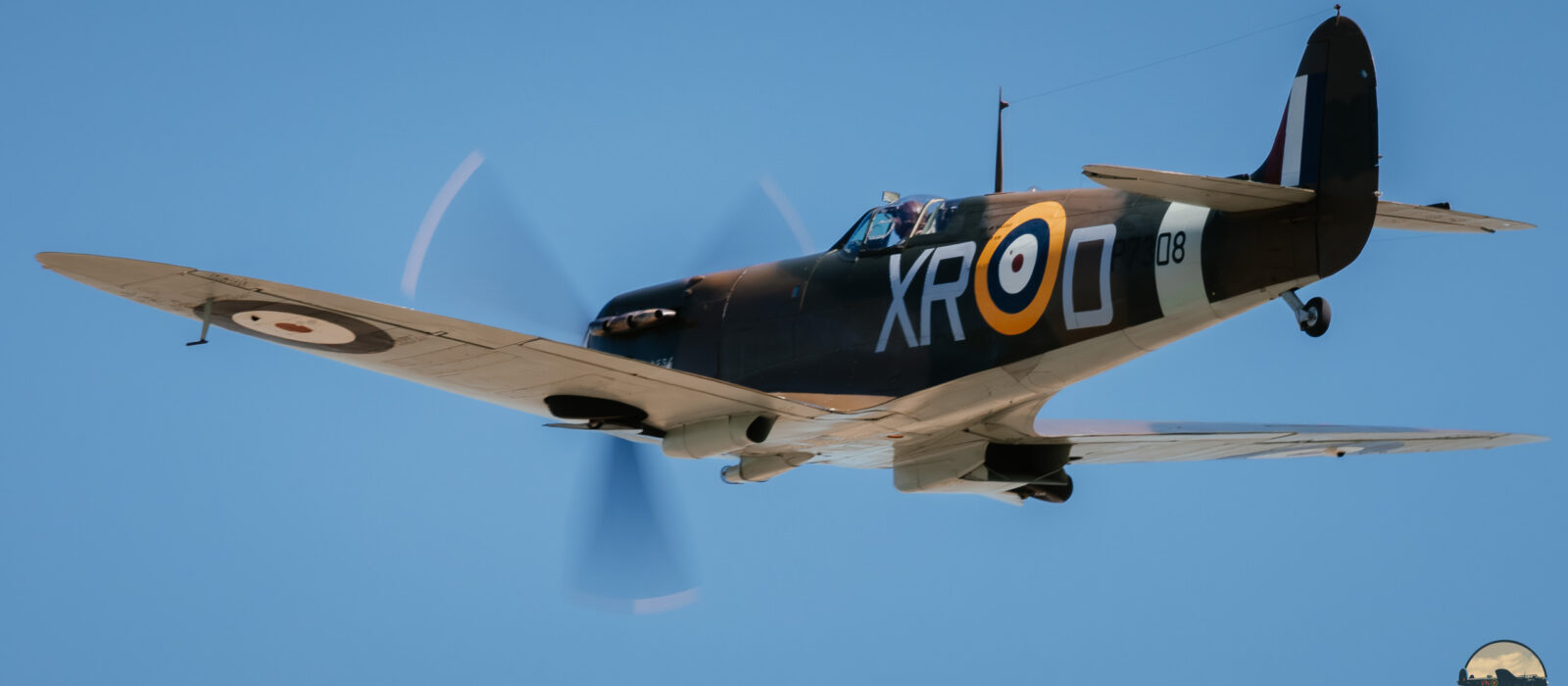
Today, the aircraft flies as G-AIST, wearing the markings of No. 71 “Eagle” Squadron RAF, with the code XR-D. The Eagle Squadrons were formed from American volunteers who joined the RAF before the United States entered the war. These pilots flew alongside their British and Commonwealth comrades in the defence of Britain and later in offensive operations over occupied Europe. One of their most notable pilots, William R. Dunn, became the first American fighter ace of the Second World War while serving with the RAF.
The aircraft’s current appearance is a tribute to that remarkable chapter of Anglo-American aviation history. Its markings recall the American volunteers who crossed the Atlantic to fight for Britain, while the Spitfire itself remains a symbol of the skill, courage and determination of an entire generation.
With its classic camouflage, distinctive squadron codes and powerful Merlin soundtrack, P7308 continues to capture the imagination wherever it appears. It is a reminder that the Spitfire’s legacy extends beyond its combat record: it also tells the story of preservation, remembrance and the enduring fascination of historic aviation.