 By DrSoda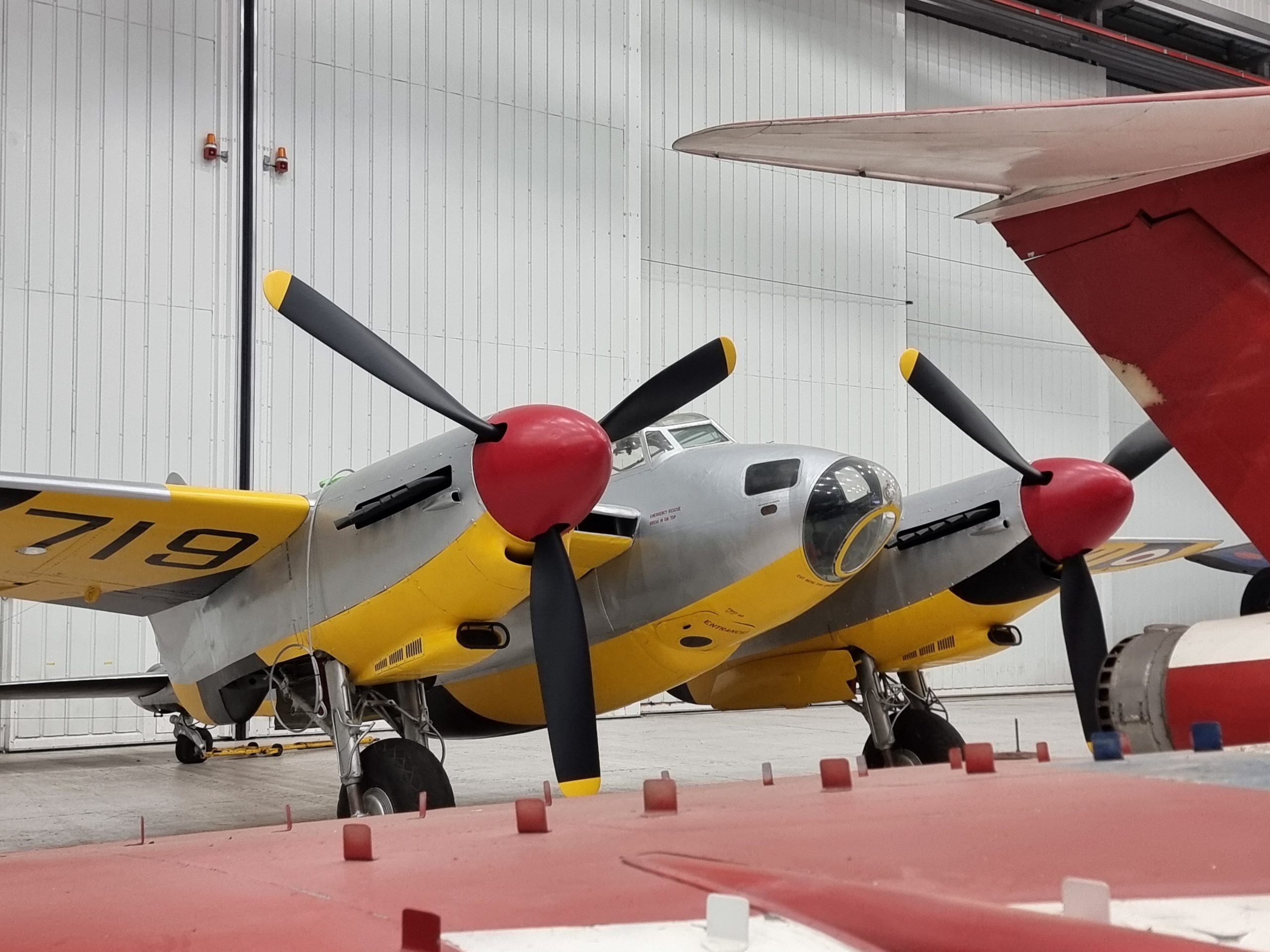
On 25th November 1940, an aerial legend first took to the skies. Initially developed as an unarmed fast bomber, the de Havilland Mosquito evolved throughout the war to become a reliable and remarkable multi-role aircraft. It fulfilled roles including low to medium altitude daytime tactical bombing, high-altitude night bombing, night fighter duties, pathfinding, maritime strike, intruder missions, and photo reconnaissance.
Despite initial skepticism from the Air Ministry regarding the need for an unarmed bomber, the fighter variant secured its place in RAF service, with 7,781 aircraft built by 1950.
Design
Designed and built to the British Air Ministry Specification P.13/36 for a twin-engined medium bomber capable of carrying a payload of 3,000 lbs with a range of 3,000 miles and a top speed of 275 mph at 15,000 ft, as well as carrying an 8,000 lbs bomb load over a shorter distance.
Competing with Avro’s Manchester and Handley Page’s Halifax, Geoffrey de Havilland drew inspiration from his earlier aircraft, the DH.91 Albatross—a pre-war, four-engined ply-balsa-ply sandwich constructed plane originally built as a transatlantic mail aircraft. De Havilland advanced the use of timber construction while other companies considered it outdated.
After considering modifications to the existing Albatross design to meet the requirements, de Havilland remained convinced they could exceed the Specification’s demands. Returning to the drawing board, they designed a new aircraft from scratch. Utilizing ply-balsa-ply construction, a smooth aerodynamic finish, and the power of the readily available Rolls-Royce Merlin engine, the Mosquito began to take shape. De Havilland quickly decided that the best defense for the Mosquito was speed, opting to exclude defensive turrets or any forward-facing armament.
Initially, the Air Ministry viewed the design as too radical, favoring heavily armed aircraft with turrets for defense. However, after the war broke out, they became more receptive to the idea, allowing de Havilland to continue development and build a prototype. Despite this, they never fully believed the design would succeed.
Prototype
On 25th November 1940, piloted by test pilot Geoffrey de Havilland Jr., the yellow-painted prototype E-0234 took to the skies from Hatfield Aerodrome. Powered by two Merlin 21 two-speed supercharged engines, the aircraft reached a speed of 220 mph. As test flights occurred, issues were addressed, such as buffeting when speeds exceeded 240 mph, which was resolved by introducing triangular fillets to the trailing edge of the wings, smoothing the airflow and directing it away from the tailplane. The landing gear doors didn’t fully close due to the use of bungee cords attached to the undercarriage legs. Also, the left wing angle had to be adjusted as it tended to drag more than the right wing.
Trials continued, and as they did, the Mosquito began to establish itself as a necessary aircraft for the RAF. It outpaced a Spitfire Mk II during the trials, truly opening the eyes of the Air Ministry. Now with a military registration, W4050, official trials started at Boscombe Down on 19th February, and it was found that the Mosquito had a top speed of 388 mph at 22,000 ft, a maximum ceiling of 34,000 ft, and a rate of climb of 2,880 ft per minute.
In late October 1941, W4050 was fitted with Merlin 61 engines for testing and reached new top speeds of 428 mph at 28,500 ft with fitted snow guards, and 437 mph at 29,200 ft without the snow guards.
Production
On 21st June 1941, the Air Ministry approved the mass production of the Mosquito, which by then held the title of the world’s fastest operational aircraft.
This decision took full advantage not only of the vast supplies of plywood and balsa wood but also of a large population of carpenters who had originally been building furniture. These craftsmen leveraged their experience and expertise to build the Wooden Wonder while their skills were not being utilized by the war effort.
By this time, there were multiple variants of the Mosquito: Photo-Reconnaissance (PR), Fighter (F), Bomber (B), Fighter-Bomber (FB), Night Fighter (NF), Torpedo Bomber (TB), and Trainer (T). The most common armament configuration consisted of four .303 Browning machine guns and four 20mm Hispano autocannons mounted under the cockpit in the main fuselage, as well as a bomb capacity of 4,000 lbs, allowing the Mosquito to carry Cookie Blockbuster bombs.
Of all the variants built, the FB Mk VI was produced the most. Powered by Merlin Mk 23 or 25 engines and three-bladed de Havilland Hydromatic propellers, these aircraft had a balanced fixed loadout of the above armament and 2,000 lbs of bombs.
Operation
The Mosquito truly excelled at handling any mission it was assigned when pushed into service; however, some operations became more famous than others. First, the Oslo Mosquito Raid on September 25, 1942: four Mosquitos from No. 105 Squadron, each armed with two delayed-action 1000 lb bombs, were tasked with bombing the Victoria Terrasse building, then used as the Gestapo headquarters in Norway. One Mosquito was lost during the raid, and the mission was considered a failure due to minimal damage. However, the raid was dramatic enough that the Mosquito was publicly revealed to the world the following day.
As time went on, tactics and pilot skill evolved with daylight precision and intruder strikes, exemplified on January 30, 1943. Luftwaffe Chief Reichsmarschall Hermann Göring gave a speech commemorating the 10th anniversary of the Nazi Party’s rise to power in Germany. A Mosquito attack took down the Berlin Broadcasting Station, perfectly timed as Mosquitos could be heard flying over Göring during the broadcast, just as he assured the German people that Allied planes would not fly over Berlin. To prove it was no fluke, Mosquitos carried out the exact same raid that afternoon targeting Propaganda Minister Joseph Goebbels.
Göring was furious—not only at the possibility but the fact that Britain had achieved this with a wooden aircraft—as he lectured German aircraft manufacturers.
In 1940 I could at least fly as far as Glasgow in most of my aircraft, but not now! It makes me furious when I see the Mosquito. I turn green and yellow with envy. The British, who can afford aluminium better than we can, knock together a beautiful wooden aircraft that every piano factory over there is building, and they give it a speed which they have now increased yet again. What do you make of that? There is nothing the British do not have. They have the geniuses and we have the nincompoops. After the war is over I’m going to buy a British radio set – then at least I’ll own something that has always worked
Survivers
There are only 30 registered Mosquitos left in the world, with 5 in airworthy condition and 7 under restoration. Sadly, the UK lost its flying Mosquito in 1996 in an incident. However, The People’s Mosquito charity is working tirelessly to get another one back in the air for the UK display circuit. Tony Agar has HJ711, a Night Fighter variant, in taxiable condition at the Lincolnshire Aviation Heritage Centre in East Kirkby.
There is also a resurgence of Mosquito aircraft coming from restorers Avspecs in New Zealand. Let’s hope a few more return to the skies through their skilled efforts and that another example flies in the UK sooner rather than later.