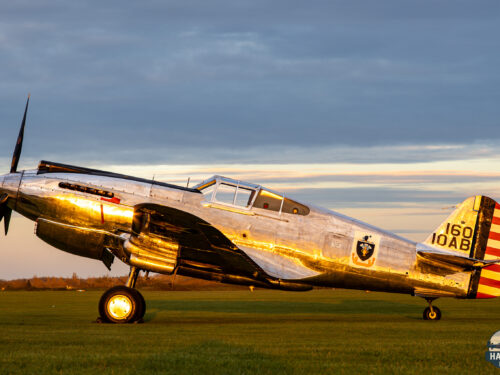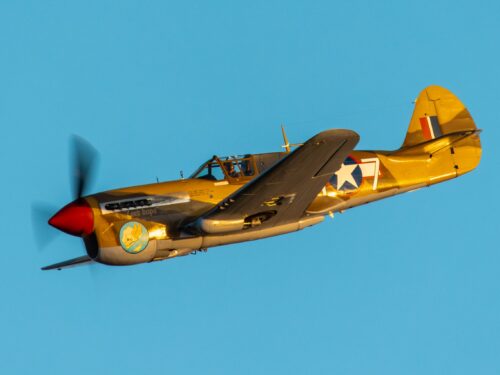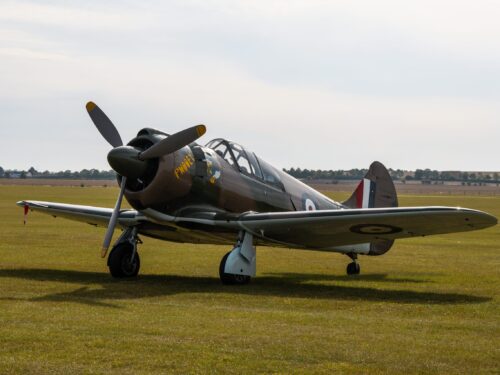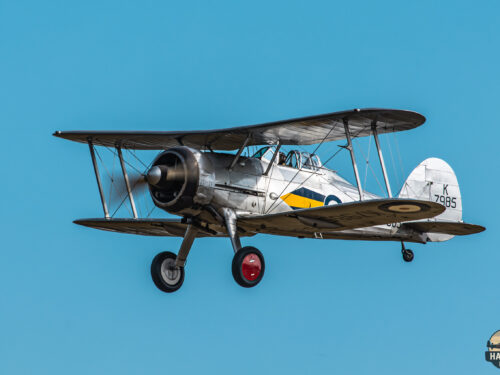
Before the P-40 Warhawk became one of America’s best-known fighters of the Second World War, Curtiss had already created an important fighter design in the Model 75, better known as the Hawk 75. Sleek, compact and powered by a radial engine, it was the predecessor of the P-36 and helped establish Curtiss as a major supplier of fighters to Allied air forces. Today, G-CCVH is a rare flying survivor of the aircraft that fought for France during the desperate opening months of the war in Western Europe.
Built in 1939, this aircraft carries construction number 12881 and was one of the first 100 Hawk 75A-1 fighters ordered by France. It entered service with the Armée de l’Air in April 1939, as France prepared for the possibility of war with Nazi Germany. It was allocated military number 82 and associated with Groupe de Chasse II/5, a fighter group with a proud heritage linked to the famous Lafayette Escadrille of the First World War. The unit’s Sioux-head emblem reflected that tradition of French-American aviation cooperation.
When Germany invaded France in May 1940, the Hawk 75 found itself facing the Luftwaffe’s Bf 109 and Bf 110 fighters. Although the Hawk was not as fast as the latest Bf 109E, it was manoeuvrable, robust and effective in the hands of experienced pilots. French Hawk units fought throughout the Battle of France, and their pilots achieved notable successes against German aircraft despite the increasingly difficult strategic situation. Aircraft 82 is credited in historical accounts with two victories during May 1940, giving this particular survivor a connection to the fighting over France.
Following the French armistice in June 1940, the aircraft’s story continued in North Africa. Like other French fighters, it remained in service under the changing political circumstances that followed France’s defeat. After the war, Hawk 75 No. 82 returned to France and served as an advanced trainer with the 4th Training Squadron at Cazaux. Its career therefore extended beyond the desperate combat of 1940, continuing into the post-war period as the French Air Force rebuilt and modernised.
The aircraft’s survival was far from guaranteed. Saved from scrapping in the 1950s, it was placed in storage in France for decades. The Fighter Collection acquired it in 1995 and arranged a major restoration to flying condition. Work involved specialists in several countries: the aircraft was restored in the United States, its wings were rebuilt in New Zealand, and its Pratt & Whitney radial engine was overhauled in Idaho. After its first post-restoration flight on 13 October 2004, it returned to Duxford in early 2005 and made its public debut at the Flying Legends airshow that summer.
The Hawk 75A-1 was powered by a Pratt & Whitney R-1830 Twin Wasp, a 14-cylinder air-cooled radial engine producing approximately 1,050 horsepower. Its armament comprised four 7.5 mm machine guns in the original French configuration. Unlike later wartime fighters, it had no heavy cannon armament, but its combination of handling, reliability and a relatively wide undercarriage made it a capable fighter for its time. Its radial engine also gave it a distinctive profile, setting it apart from the liquid-cooled, inline-engined fighters that became increasingly common during the war.
Today, G-CCVH is associated with The Fighter Collection and is a treasured presence at historic aviation events. Its French camouflage and markings recall the air force that operated it in 1940, while its long journey from frontline fighter to trainer, stored airframe and restored warbird makes it a survivor of unusual significance. When the Hawk 75 takes to the air, it represents an often-overlooked chapter of the Battle of France — the story of the French fighter pilots who fought with determination during one of the most critical campaigns of the Second World War.