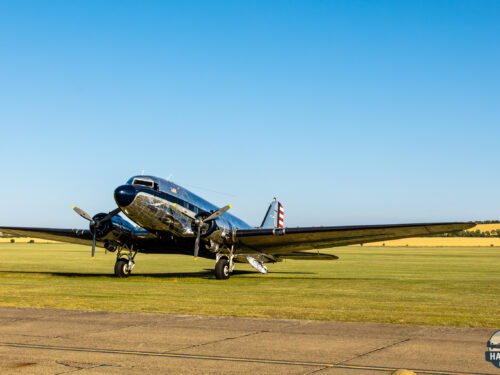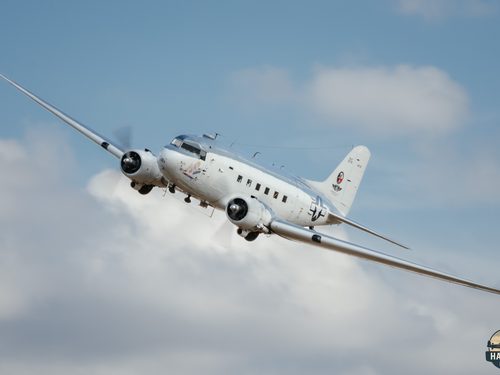
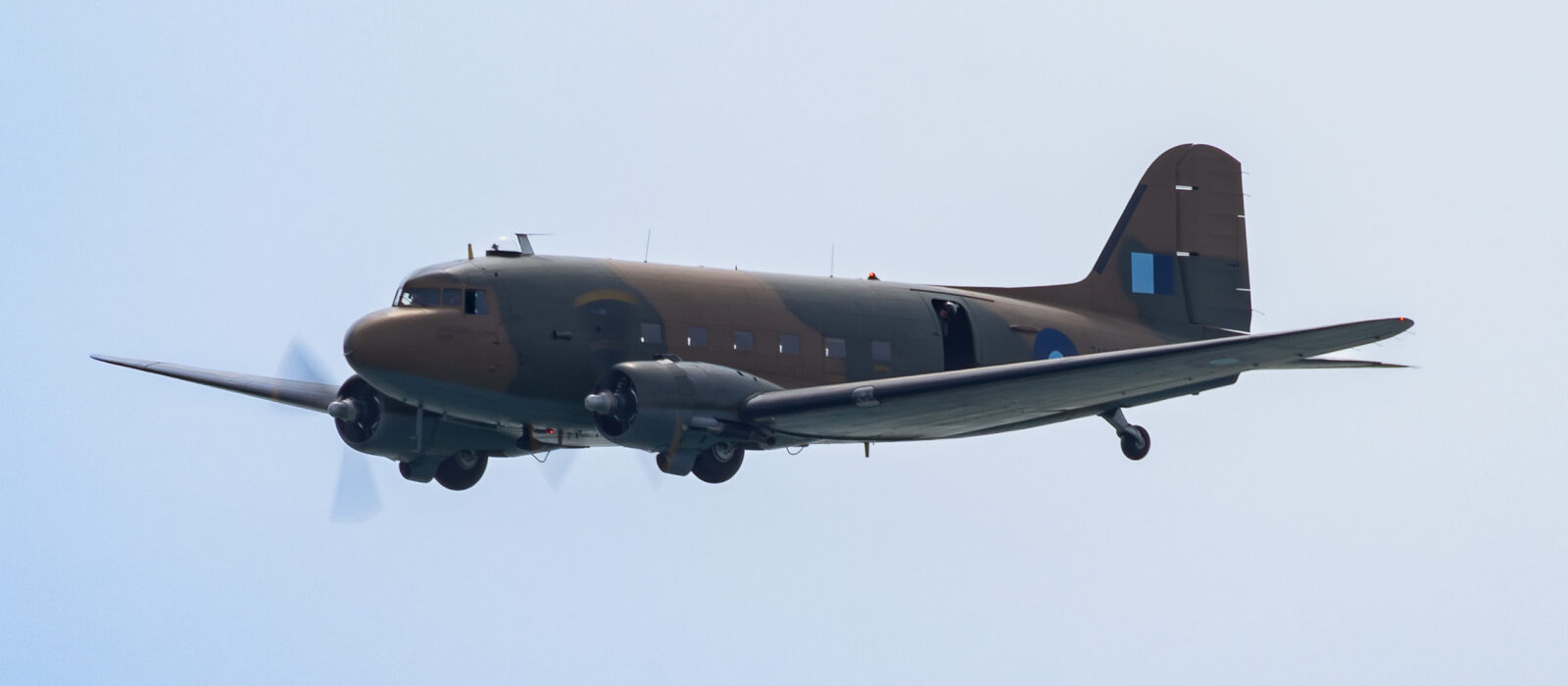
Robust, dependable and instrumental to Allied victory, the Douglas C-47 Dakota ZA947 represents one of the most important transport aircraft of the Second World War. Developed from the successful Douglas DC-3 airliner, the C-47 became the backbone of Allied airborne operations, carrying paratroopers, towing gliders, delivering supplies and evacuating wounded troops from battlefields across Europe and beyond. Today, ZA947 serves with the Royal Air Force’s Battle of Britain Memorial Flight (BBMF), preserving the legacy of the transport crews whose work was essential to the success of Allied operations.
Built by Douglas Aircraft Company at Long Beach, California, in March 1942, the aircraft originally carried the United States Army Air Forces serial 42-24338. In September 1943, it was transferred to the Royal Canadian Air Force, where it served as Dakota 661. It remained in Canadian service until 1971, when it was declared surplus and acquired by the Royal Aircraft Establishment at Farnborough in Britain. Initially assigned the British military serial KG661, the aircraft was later redesignated ZA947 after research revealed that the original KG661 had been lost in an accident.
During its years with the Royal Aircraft Establishment and its successor organisations, ZA947 undertook a variety of experimental and support duties. These included trials involving sonobuoys and remotely piloted vehicles, demonstrating the Dakota’s adaptability long after its original wartime role. When the aircraft became surplus to requirements in 1992, it was adopted by RAF Strike Command and joined the BBMF in March 1993.
The Dakota has since become an important part of the Flight’s work. Alongside its public displays and commemorative flypasts, it provides valuable training for RAF aircrew, particularly those preparing to fly the BBMF’s larger historic aircraft. Its tailwheel configuration and multi-engine handling characteristics make it a particularly useful training platform, while its ability to carry parachutists allows it to participate in airborne commemorations.
ZA947 has worn several historic liveries during its time with the BBMF, each reflecting a different chapter in the Dakota’s wartime story. For many years, it represented an aircraft associated with Flight Lieutenant David Lord VC and the airborne operations around Arnhem in September 1944. More recently, it wore the markings of FZ692, a Dakota of No. 233 Squadron, commemorating the aircraft that took part in the D-Day airborne operations and subsequent casualty-evacuation missions.
Following an extensive major maintenance programme at the Aircraft Restoration Company at Duxford, ZA947 returned to RAF Coningsby on 29 August 2025, after more than three years away. The work had been extended by the discovery of corrosion, airframe damage and cracking around structural wing attachments. Its return was an important milestone for the BBMF, ensuring that this veteran aircraft could continue flying for years to come. In its new markings, it represents a No. 31 Squadron Dakota serving with South East Asia Command, reflecting the aircraft’s long association with the wider story of RAF transport operations.
The Dakota’s reputation was forged during some of the most significant operations of the Second World War. On D-Day, C-47s carried Allied paratroopers into Normandy under difficult night-time conditions. In September 1944, they transported airborne forces to the Netherlands during Operation Market Garden, while other Dakotas flew dangerous supply and casualty-evacuation missions. Their ability to operate from relatively short, rough airstrips made them indispensable wherever troops needed to be moved quickly.
Powered by two Pratt & Whitney R-1830 Twin Wasp radial engines, the C-47 was capable of carrying up to several dozen troops or a substantial cargo load, depending on the mission. Its simple, rugged design and ease of maintenance helped make it one of the most widely used military transports of the war. More than 10,000 military variants were produced, and the basic DC-3 design continued in civilian and military service for decades.