Few aircraft have served in as many different roles as the Douglas DC-3 and its military derivatives. Known as the C-47 Skytrain in US Army service and the Dakota in British and Commonwealth service, this rugged twin-engine transport became one of the most important aircraft of the Second World War. Yet “Ready 4 Duty” is no ordinary Dakota. This veteran is a Douglas R4D-6S, the US Navy’s specialised version of the aircraft, and its career included transport duties, airborne electronics testing and a remarkable connection to the Allied victory in the Atlantic.
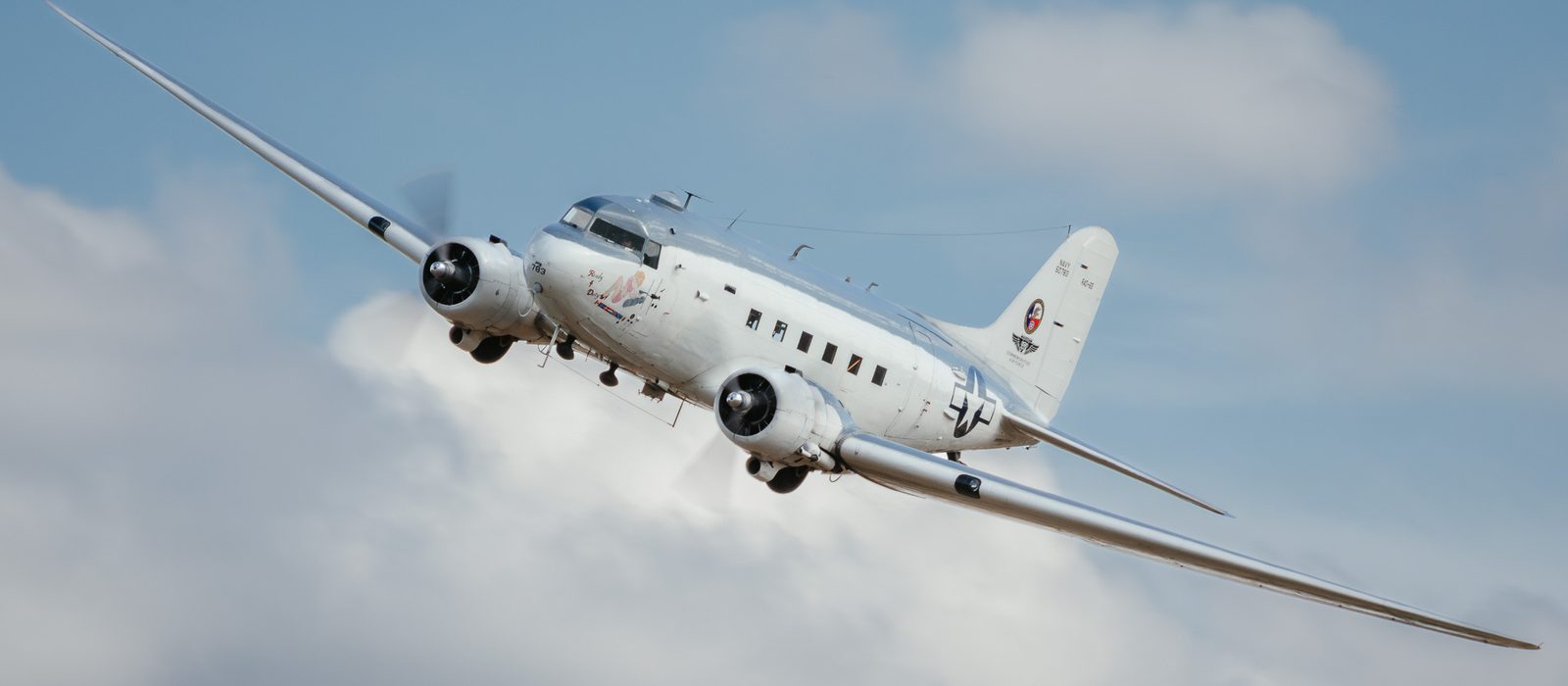
Built in 1944, the aircraft originally carried US Army serial 43-49147. It was transferred to the US Navy before entering service as Bureau Number 50783, becoming an R4D-6. It was subsequently modified to the R4D-6S configuration, a specialised variant equipped for naval search and electronic systems work. Its military designation changed again in 1962, when it became known as a C-47J under a US Navy re-designation programme. Today it flies under the American civil registration N151ZE, wearing the Navy markings and the name “Ready 4 Duty”.
During its early service, the aircraft was associated with the Naval Air Transport Service, including transport work with VR-3. Like other members of the DC-3 family, it could carry personnel, supplies and casualties over long distances while operating from airfields with relatively basic facilities. The aircraft’s rugged construction, reliable radial engines and forgiving handling made it ideal for these duties. Unlike the better-known C-47s that carried paratroopers and supplies into Normandy and across Europe, however, this aircraft’s history was shaped by the US Navy’s very different operational requirements.
One of the most distinctive aspects of “Ready 4 Duty” is its association with naval anti-submarine and electronic warfare work. In its R4D-6S configuration, it was equipped to support airborne search radar and sonar evaluation and to train specialists and operators. The aircraft was modified to carry depth charges on external racks beneath the fuselage, between the main landing gear. It also carried an array of antennas and other equipment that distinguished it from a standard transport Dakota. Its operational history is associated with the Atlantic and Caribbean, with reported journeys extending to Greenland, Iceland and South America.
The aircraft’s wartime story also carries a particularly striking claim: the Commemorative Air Force records that it was among a squadron of aircraft involved in operations that surprised and sank a surfaced German U-boat off Brazil in February 1945. While the CAF includes this episode in its official history, other aviation accounts note that the specific connection has not been independently confirmed. It is therefore best treated as a reported part of the aircraft’s history rather than an undisputed individual combat achievement. Even without that claim, its specialised Atlantic service reflects the important role played by naval aviation in protecting Allied shipping and countering the German submarine threat.
After the war, 50783 continued serving the US Navy. It was used in electronic warfare training and evaluation before leaving naval service in 1959. It subsequently entered civilian government service, including work with the US Department of Agriculture’s forestry operations, and later served with Florida’s Division of Forestry. These later duties were a world away from its naval origins, but they demonstrated the remarkable adaptability of the DC-3 design. In 1983, the aircraft joined the organisation then known as the Confederate Air Force, which later became the Commemorative Air Force (CAF), and was restored to a military-style appearance.
Powered by two Pratt & Whitney R-1830 Twin Wasp radial engines, “Ready 4 Duty” retains the characteristic sound and profile of the classic Dakota. The R4D-6S has a wingspan of approximately 95 feet 6 inches and a published maximum speed of around 224 mph. Its familiar high-wing configuration, tailwheel undercarriage and robust airframe make it instantly recognisable, while its antennas and naval markings hint at the specialist work it performed. It is a reminder that the DC-3 family was not merely a transport aircraft, but a platform that could be adapted for a remarkable variety of military missions.
In 2025, “Ready 4 Duty” returned to Britain as part of the Commemorative Air Force’s “Navy to Victory Tour”, marking the 80th anniversary of the Allied victory in the Second World War. The tour crossed the Atlantic and visited locations in the United Kingdom and mainland Europe. One of its purposes was to honour the service and sacrifice of Allied personnel, including RAF airmen who trained in the United States. The aircraft had last visited the UK in 1985, making its return roughly four decades later especially memorable for aviation enthusiasts.
Today, “Ready 4 Duty” is operated by the Commemorative Air Force and based in Texas. Its continued airworthiness preserves a distinctive chapter of US naval aviation: the transport crews, radar specialists and electronics operators whose work helped keep the Atlantic routes open and supported the development of airborne surveillance. When this veteran R4D passes overhead, it carries more than the familiar silhouette of a Dakota. It represents a less familiar but equally important side of the Allied air war — one built around transport, technology, patrol and the steady work of keeping people and equipment moving.