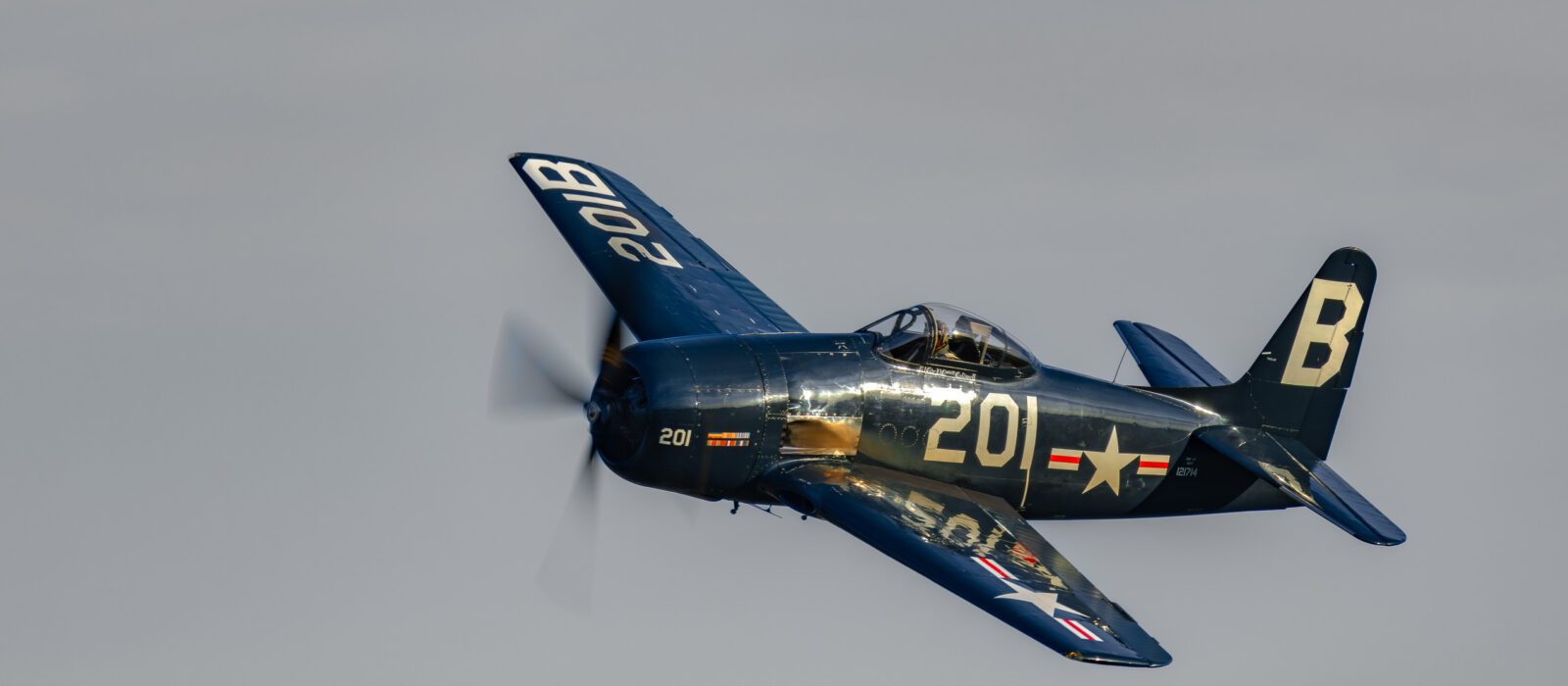
Small, powerful and astonishingly fast, the Grumman F8F-2P Bearcat G-RUMM represents the ultimate evolution of Grumman’s piston-engined naval fighters. Designed during the final years of the Second World War, the Bearcat was built around one overriding objective: to create a compact, lightweight carrier fighter with exceptional acceleration, climb performance and manoeuvrability. Although it arrived too late to fight in the war against Japan, it became one of the most formidable propeller-driven fighters of the post-war era.
G-RUMM was built in 1948 and delivered to the United States Navy in August of that year, carrying Bureau Number 121714 and construction number D-1088. It originally entered service as an F8F-2 before being converted to the F8F-2P photographic reconnaissance configuration in 1952. The reconnaissance variant was equipped to carry cameras for aerial intelligence work, adapting the Bearcat’s exceptional performance to a role where speed and the ability to reach a target quickly were invaluable. The aircraft remained in US Navy service until January 1957, when it was officially struck off charge.
The Bearcat had been developed as a successor to the successful F6F Hellcat. Drawing on combat experience from carrier operations in the Pacific, Grumman engineers produced an aircraft that was significantly smaller and lighter than its predecessor, yet retained the powerful Pratt & Whitney R-2800 Double Wasp radial engine. The result was an exceptionally agile fighter with a remarkable rate of climb. Its short, compact fuselage, broad wings and large radial engine gave it a distinctive appearance, while its robust landing gear and folding wings made it well suited to the demanding environment of aircraft carriers.
After leaving military service, BuNo 121714 passed into civilian ownership in the United States. It spent time with the Air Museum associated with Ed Maloney in California before passing to private owners in Tennessee. During the 1970s, the aircraft underwent a major overhaul and returned to flight in 1975. Its next chapter began in 1981, when it was brought to Britain to join The Fighter Collection at Duxford. It would go on to become one of the collection’s longest-serving aircraft, delighting audiences with its extraordinary performance and distinctive radial-engine roar.
The Bearcat initially appeared in markings associated with US Navy fighter squadron VF-11, before receiving its familiar blue naval scheme. Today, G-RUMM wears the identity of US Navy aircraft 121714, with the code 201/B. Its polished details and deep-blue finish provide a striking contrast to the olive-drab and grey fighters more commonly associated with the Second World War. Although the aircraft never saw wartime combat, its authentic post-war Navy history makes it an important survivor of the era when piston-engine fighters were reaching the limits of their performance.
The F8F-2 was powered by the Pratt & Whitney R-2800, producing well over 2,000 horsepower. Depending on configuration and conditions, the Bearcat could reach speeds in excess of 450 mph, placing it among the fastest production piston-engined fighters of its time. The standard F8F-2 carried four 20 mm cannon, while the F8F-2P reconnaissance variant was adapted for its photographic role. Its combination of power, low weight and superb climb performance meant that it could outperform many early jet aircraft in certain aspects of flight.
The Bearcat also saw combat after the Second World War. French forces used the type extensively during the conflict in French Indochina, where it flew ground-attack and close-support missions. Other examples served with air arms in Asia, extending the aircraft’s operational story well beyond its original American naval role.
G-RUMM is a rare reminder of the brief but remarkable period when the piston-engine fighter reached its peak. From its post-war US Navy service to decades of civilian ownership and its long association with Duxford, it has survived to demonstrate the engineering ambition of Grumman’s final generation of propeller-driven fighters. When the R-2800 fires up and the Bearcat accelerates into the sky, its compact form and astonishing power make it easy to understand why this aircraft earned such a formidable reputation.