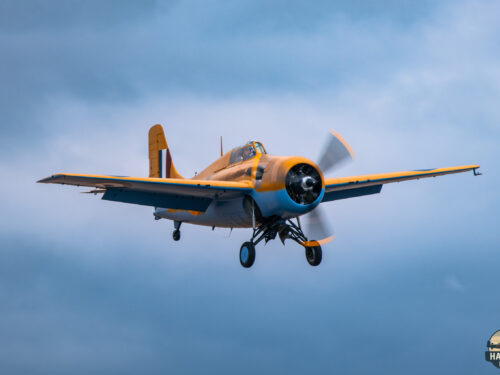
Compact, rugged and built for the demanding world of carrier aviation, the Grumman FM-2 Wildcat G-RUMW represents one of the most important naval fighters of the Second World War. Although smaller and less manoeuvrable than some of its opponents, the Wildcat earned a formidable reputation for toughness and reliability. Its contribution to the Allied war effort was particularly important aboard escort carriers, where it protected convoys, supported amphibious operations and helped defend Allied ships against enemy aircraft.
This aircraft was built not by Grumman itself, but by the Eastern Aircraft Division of General Motors, which took over much of Wildcat production so Grumman could concentrate on manufacturing the newer F6F Hellcat. Carrying US Navy Bureau Number 86711, G-RUMW was accepted into service on 24 July 1945. With the war drawing to a close, it was sent almost immediately into storage at Naval Air Station Tillamook, Oregon, and was struck off the US Navy’s books in February 1946.
The FM-2 was the ultimate production development of the Wildcat family. Optimised for operations from the small escort carriers that were vital to Allied naval strategy, it featured a more powerful Wright R-1820 Cyclone radial engine, a taller tail to improve directional stability and a lighter structure than earlier versions. Its four .50-calibre Browning machine guns provided substantial firepower, while its rugged construction made it well suited to the challenges of carrier operations. More than 4,000 FM-2 Wildcats were produced, making it the most numerous version of the type.
After leaving military service, BuNo 86711 passed through private ownership in the United States. It was registered as N4845V and eventually placed on display at the Chennault Air Museum. In the early 1990s, it was moved to Chino, California, where Fighter Rebuilders undertook a major restoration to flying condition. The Wildcat returned to the air in January 1993, marking the beginning of a new chapter in its life as a historic warbird.
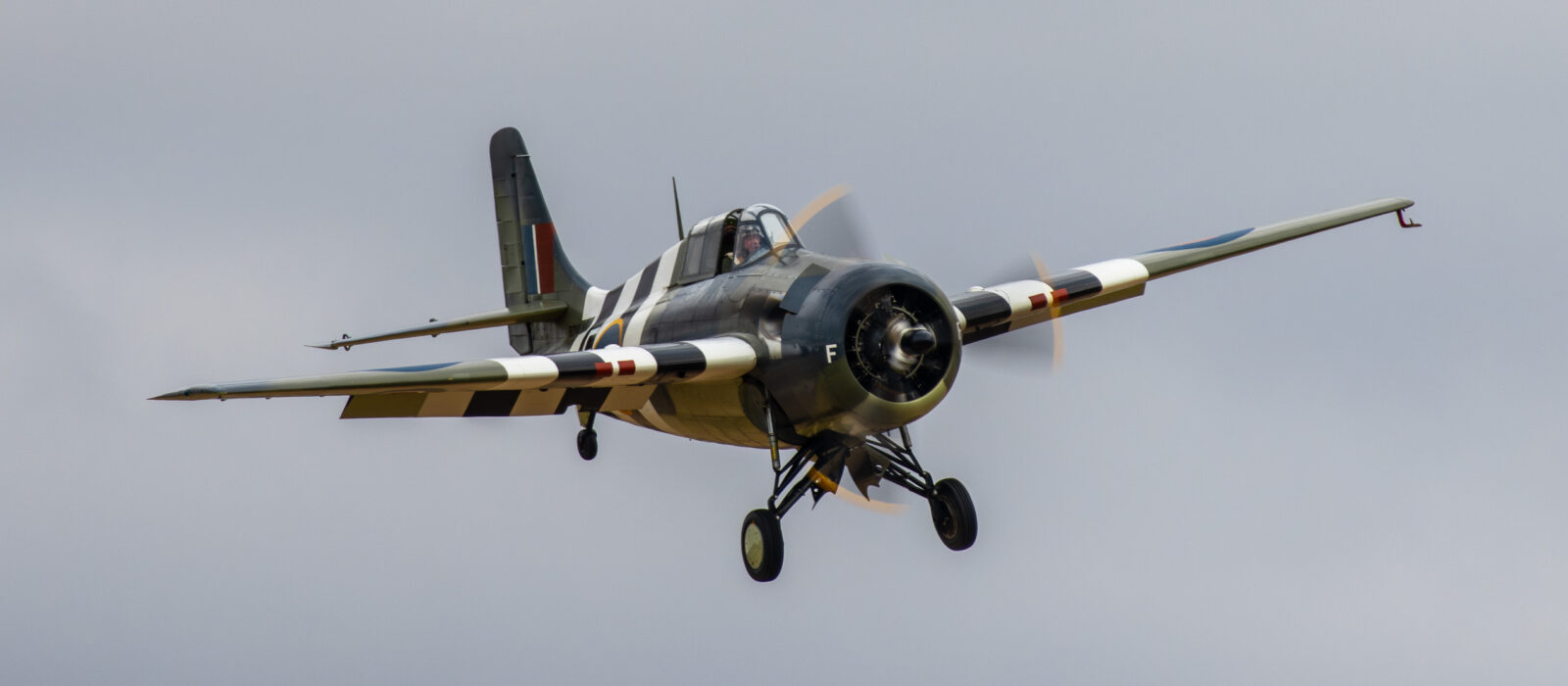
Later that year, the aircraft crossed the Atlantic to join The Fighter Collection at Duxford, becoming a familiar sight at British airshows. In 1998, it received its British civil registration, G-RUMW. Rather than wearing its original US Navy identity, it was finished in the markings of Wildcat JV579, coded “F”, representing a Fleet Air Arm aircraft associated with No. 846 Naval Air Squadron and operations from the escort carrier HMS Tracker in 1944. The scheme celebrates the Wildcat’s service with Britain’s Royal Navy, where the aircraft was initially known as the Martlet before the Fleet Air Arm adopted the American name Wildcat in 1944.
The Wildcat’s wartime reputation was built through hard fighting in both the Atlantic and Pacific. At the Battle of Midway and during the Guadalcanal campaign, Wildcats helped hold the line against Japanese naval aviation until more advanced fighters became available. In the Atlantic, carrier-based Wildcats provided fighter cover for convoys and hunted enemy aircraft threatening Allied shipping. Their strength lay not in being the fastest or most agile fighter, but in surviving damage, delivering dependable performance and enabling their pilots to exploit sound tactics.
G-RUMW is a particularly evocative survivor because its story connects American industrial ingenuity with the service of Britain’s Fleet Air Arm. From a post-war period in storage to museum display, restoration and decades of flying in the United Kingdom, it has endured a journey almost as remarkable as the aircraft’s wartime service. When its radial engine growls overhead, the Wildcat recalls the smaller escort carriers and determined aircrews that played such a vital role in securing Allied control of the seas.