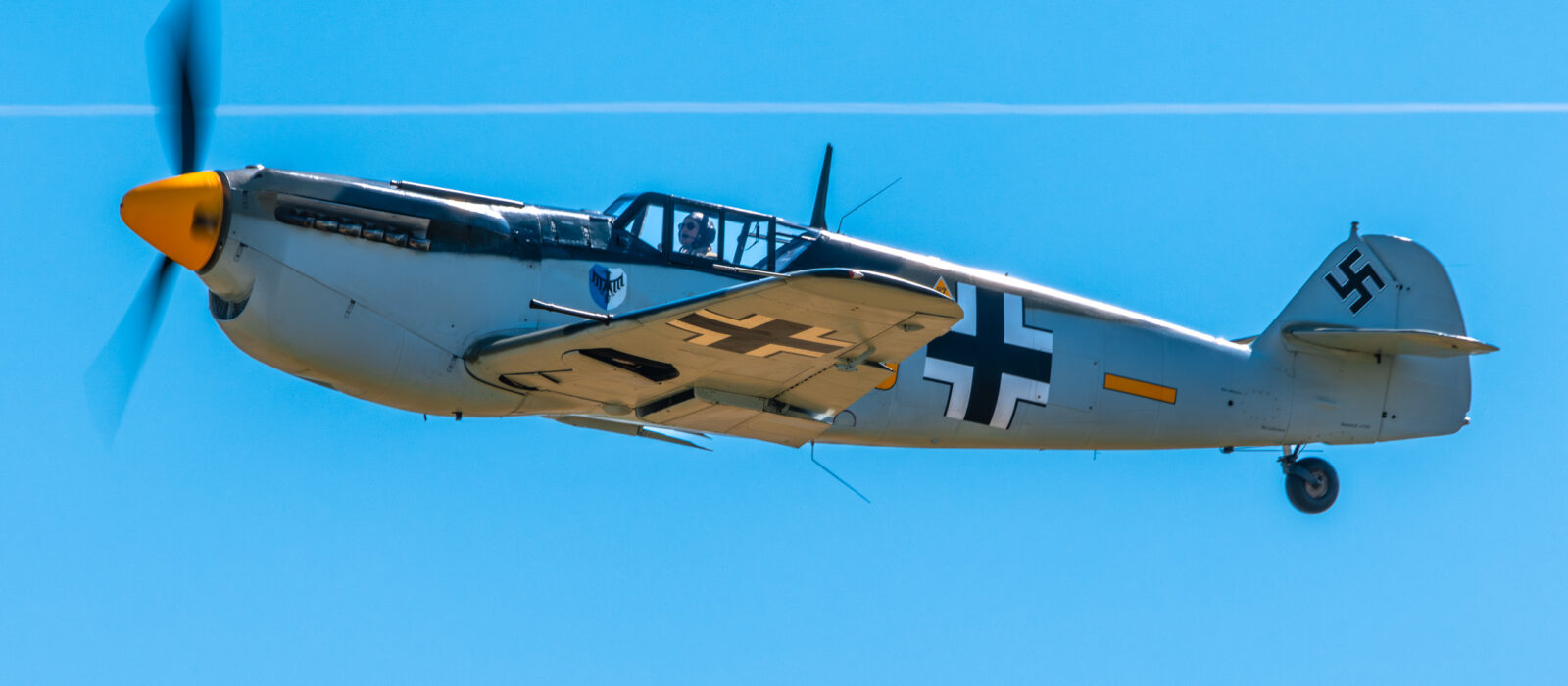
Few aircraft have such a fascinating connection between aviation history and cinema as the Hispano HA-1112-M1L Buchón. Instantly recognisable by its distinctive nose, broad wings and unmistakably Messerschmitt-inspired silhouette, the Buchón is a Spanish-built fighter developed from the legendary Messerschmitt Bf 109. Today, examples such as G-AWHK preserve the appearance of Germany’s famous wartime fighter while telling a story that continued long after the Second World War had ended.
The Buchón emerged from Spain’s need to rebuild its fighter force following the Spanish Civil War and the Second World War. Spain had operated German-designed Bf 109s during the Civil War, but acquiring further German engines and components became increasingly difficult as the conflict in Europe disrupted supplies. Hispano Aviación therefore developed a version of the Bf 109 airframe using a British engine: the Rolls-Royce Merlin.
The resulting aircraft, the HA-1112-M1L, retained the basic lines of the Bf 109 but required a redesigned forward fuselage to accommodate the larger Merlin engine. This gave the aircraft its characteristic rounded nose, which earned it the nickname Buchón—Spanish for “pigeon”, a reference to its prominent chest-like profile. Although it looked German, its engineering was a distinctly Spanish-British combination.
The Buchón entered service with the Spanish Air Force in the 1950s and remained in use into the 1960s. By then, jet aircraft were rapidly transforming military aviation, but the sturdy Merlin-powered fighters continued to serve in secondary roles. Their eventual retirement created the opportunity for surviving airframes to find a second life as warbirds, where their resemblance to the Bf 109 made them particularly valuable for historic displays and film work.
For G-AWHK, the most famous chapter began in 1968, when it appeared in the classic film Battle of Britain. One of a group of Spanish-built Buchóns acquired for the production, it was modified to resemble a Luftwaffe Bf 109E of 1940. The changes included squared-off wingtips, tailplane struts and dummy guns, helping the Spanish fighter convincingly portray the German aircraft in the film’s aerial sequences.
After filming, G-AWHK crossed the Atlantic to the United States, where it flew briefly before spending years on static display. It returned to Britain in 1993 and underwent a painstaking restoration, eventually flying again in 2006. Over the years it has appeared in several film productions, including Valkyrie and Christopher Nolan’s Dunkirk, demonstrating how valuable these surviving aircraft remain to historical filmmaking.
Today, G-AWHK is particularly recognisable in the markings of “Yellow 10”, the finish associated with its appearance in Battle of Britain. The combination of Luftwaffe camouflage and the Buchón’s unmistakable Merlin-powered nose makes it a remarkable sight in the air. Although it is not an original wartime German Bf 109, it provides an evocative impression of the aircraft that fought over Britain in 1940.
G-AWHK is a genuine aviation survivor with an extraordinary story: conceived from a German fighter design, built in Spain, powered by a British engine, flown across two continents and immortalised on film. When its Merlin engine fills the air with that familiar throaty roar, it brings to life an era when the skies over southern England were the stage for one of history’s most famous air battles.