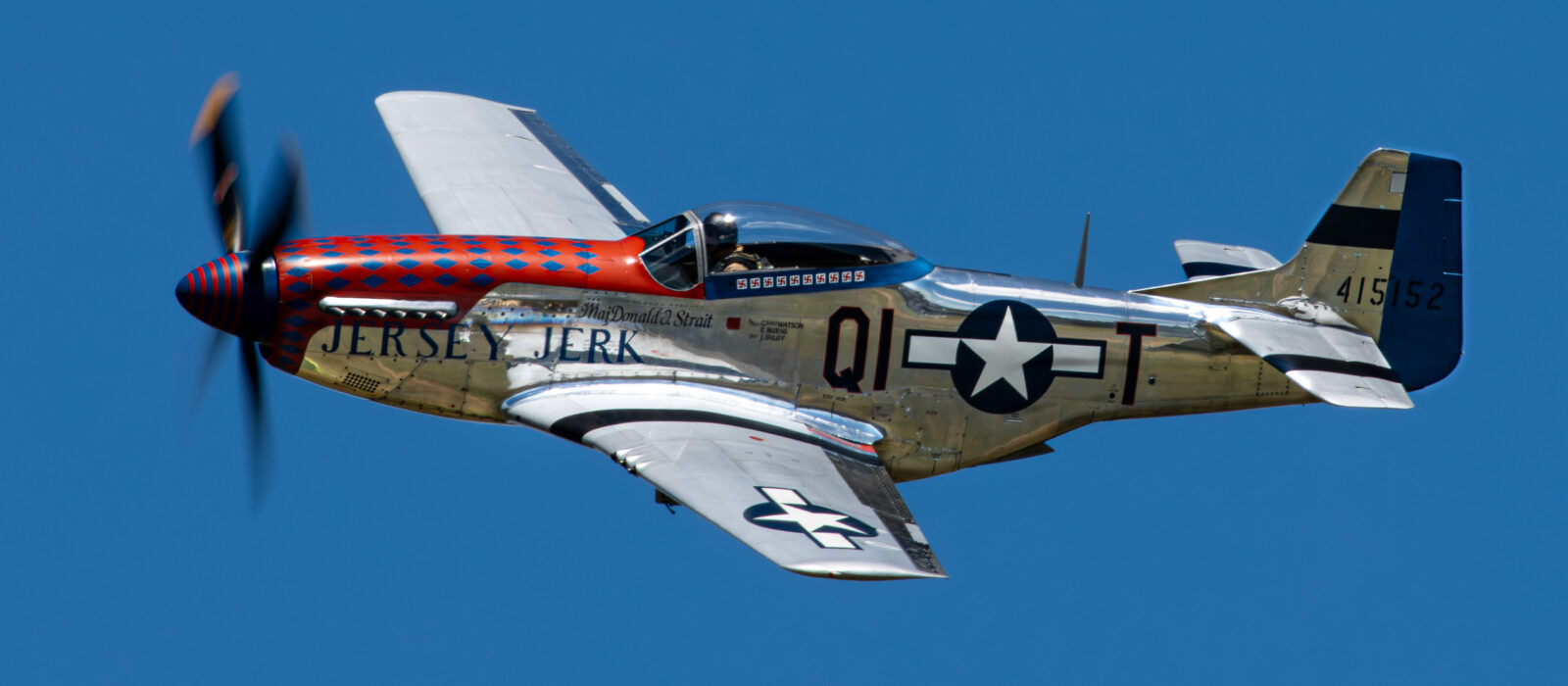
Few aircraft capture the spirit of the Allied air war over Europe quite like the North American P-51D Mustang. With its sleek lines, distinctive bubble canopy and unmistakable Rolls-Royce Merlin-derived powerplant, the Mustang became one of the most celebrated fighters of the Second World War. Today, G-JERK, wearing the striking markings of Jersey Jerk, brings the story of one of the USAAF’s most successful fighter pilots back to life on the British airshow circuit.
There is an interesting twist to this aircraft’s identity. Although it is often described as a P-51D Mustang, G-JERK is actually a Commonwealth Aircraft Corporation CA-18 Mustang Mk.21, built under licence in Australia and delivered to the Royal Australian Air Force on 20 February 1948 as A68-110. Most of its RAAF career was spent in storage, and following a taxiing accident it was struck off charge in 1957 and sold for scrap. Its survival into the modern era was far from certain.
The aircraft’s revival began decades later, when a collection of Mustang components was assembled into a restoration project in the United States. The project was shipped to Australia in 1995 and taken to Caboolture, Queensland, where it underwent an extensive reconstruction. Registered as VH-MFT, the restored Mustang made its first post-restoration flight on 24 January 2002. It subsequently spent more than two decades flying in Australia, including a period in markings representing another RAAF Mustang, Snifter.
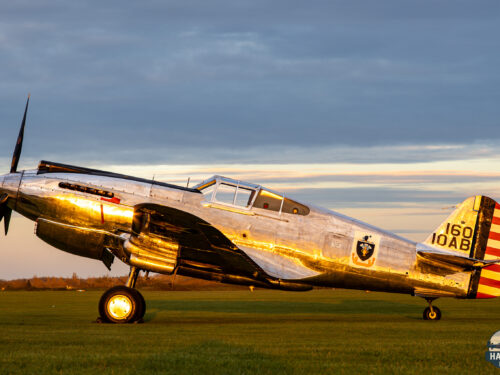
In 2023, the aircraft was sold to Ultimate Warbird Flights and shipped to the United Kingdom, arriving at Sywell Aerodrome in November. Following another transformation, it emerged in 2024 wearing the polished-metal finish and colourful markings of the wartime P-51D Jersey Jerk, USAAF serial 44-15152. The restored aircraft made its first flight in Britain in this new guise on 5 May 2024, bringing a familiar name from the history of the 8th Air Force to a new generation of enthusiasts.
The original Jersey Jerk was associated with Major Donald J. Strait, a fighter ace from New Jersey who served with the 361st Fighter Squadron, 356th Fighter Group, based at RAF Martlesham Heath in Suffolk. Strait first flew the P-47 Thunderbolt before his unit transitioned to the Mustang. Across two combat tours, he flew 122 missions and achieved 13.5 aerial victories, becoming the leading ace of the 356th Fighter Group. His Mustang carried the distinctive markings of the group’s “Blue Diamonds”, and the aircraft’s name reflected his home state.
The P-51’s success rested on more than its appearance. Powered by the Packard-built Merlin V-1650 engine, the P-51D combined high speed, strong high-altitude performance and exceptional range. Its six .50-calibre Browning machine guns provided formidable firepower, while its ability to escort Allied bombers deep into German-held territory helped transform the air war in Europe. The Mustang could engage enemy fighters while remaining with bomber formations for much longer than many earlier escort fighters.
G-JERK is therefore a fascinating blend of Australian aviation history and American wartime heritage. Its airframe began life in the post-war RAAF, while its current identity commemorates a Mustang flown during the final campaigns over Europe. When its Merlin engine roars into life and its polished wings catch the sunlight, Jersey Jerk offers a vivid reminder of the men who flew these machines and the remarkable engineering that made the Mustang a legend.