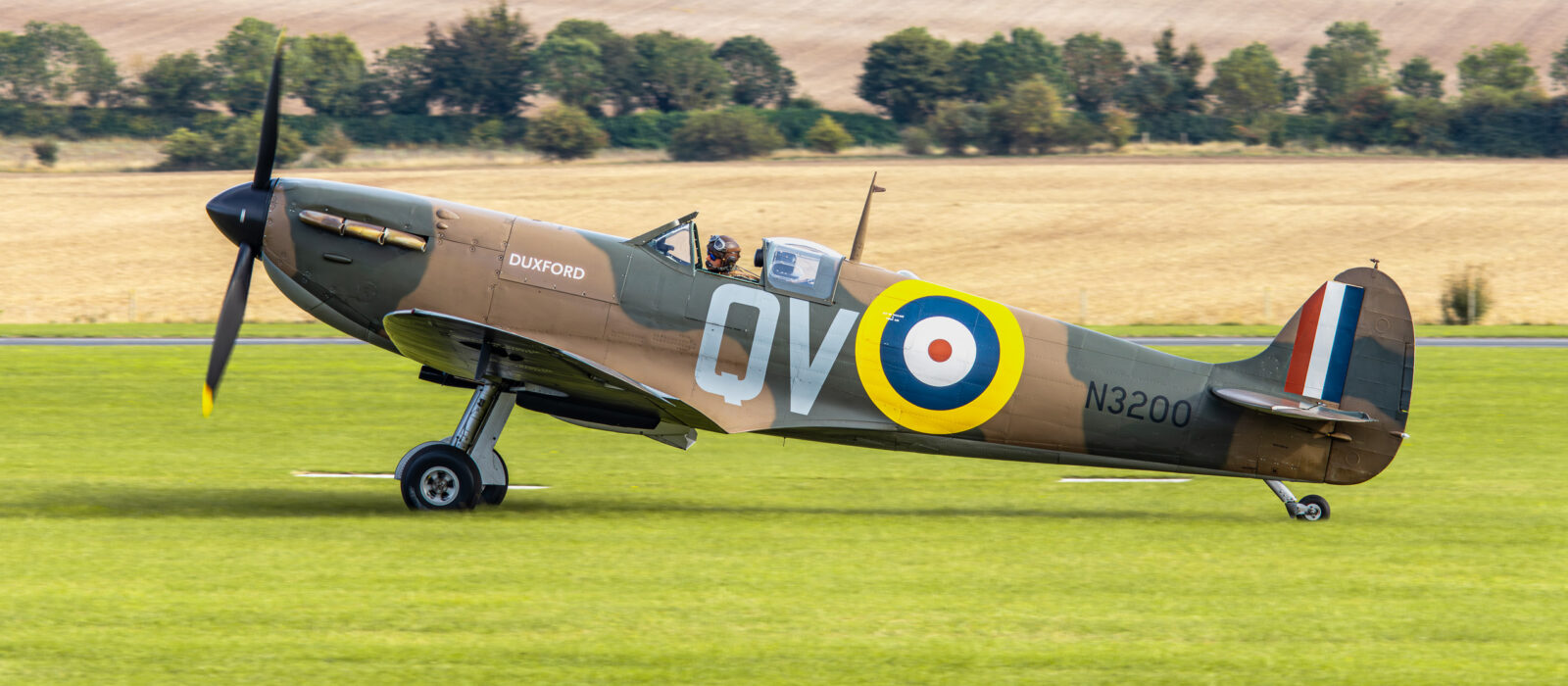
A genuine survivor of the desperate fighting over France in 1940, Supermarine Spitfire N3200 is one of the most historically significant early Spitfires still flying today. Its story is one of combat, loss, rediscovery and painstaking restoration, bringing to life the extraordinary events surrounding the evacuation of Dunkirk.
Built at Supermarine’s Eastleigh factory in Southampton, N3200 first flew on 29 November 1939. Following acceptance checks and preparation for service, it joined No. 19 Squadron RAF at Duxford on 19 April 1940, carrying the squadron code letters QV. At the time, the Spitfire Mk.I was at the forefront of British fighter technology, combining elegant aerodynamics with impressive manoeuvrability and the power of the Rolls-Royce Merlin III engine.
N3200’s operational career was tragically short. On 26 May 1940, as German forces advanced through France and British troops gathered at Dunkirk, Squadron Leader Geoffrey Stephenson, commanding officer of No. 19 Squadron, took the aircraft into action to protect the Allied evacuation. During the sortie, Stephenson engaged German aircraft and is credited in accounts of the mission with shooting down a Junkers Ju 87 Stuka. However, N3200 was hit by enemy fire, damaging its radiator and forcing Stephenson to make an emergency landing on the beach at Sangatte, near Calais. He was captured and spent the remainder of the war as a prisoner, including time at Colditz Castle.
The abandoned Spitfire remained on the beach, where tides and shifting sand gradually buried the wreckage. For decades, its location was forgotten until a storm in 1986 exposed parts of the aircraft. The remains were recovered and eventually acquired by aviation conservationists Thomas Kaplan and Simon Marsh in 2000. A painstaking restoration followed, with the team at Historic Flying Limited and other specialists working to return N3200 to as close as possible to its original 1940 configuration.
On 26 March 2014, after more than seven decades away from the skies, N3200 flew again from Duxford — the very airfield from which it had departed on its wartime missions. Its restoration preserved many distinctive early Spitfire features, making it a remarkable flying example of the aircraft as it appeared during the Battle of France. In 2015, the aircraft was donated to the Imperial War Museum, ensuring its preservation for future generations.
Today, registered G-CFGJ, N3200 remains part of the Imperial War Museum’s collection and is operated by the Aircraft Restoration Company. Its appearance in the markings of No. 19 Squadron, complete with the distinctive QV codes and black-and-white underside markings, recreates the aircraft’s final operational period in May 1940.
With its early-war configuration, elegant lines and unmistakable Merlin soundtrack, N3200 is more than a flying Spitfire. It is a tangible link to the Battle of France, the evacuation of Dunkirk and the pilots who fought to protect Allied forces during one of the most critical moments of the war.