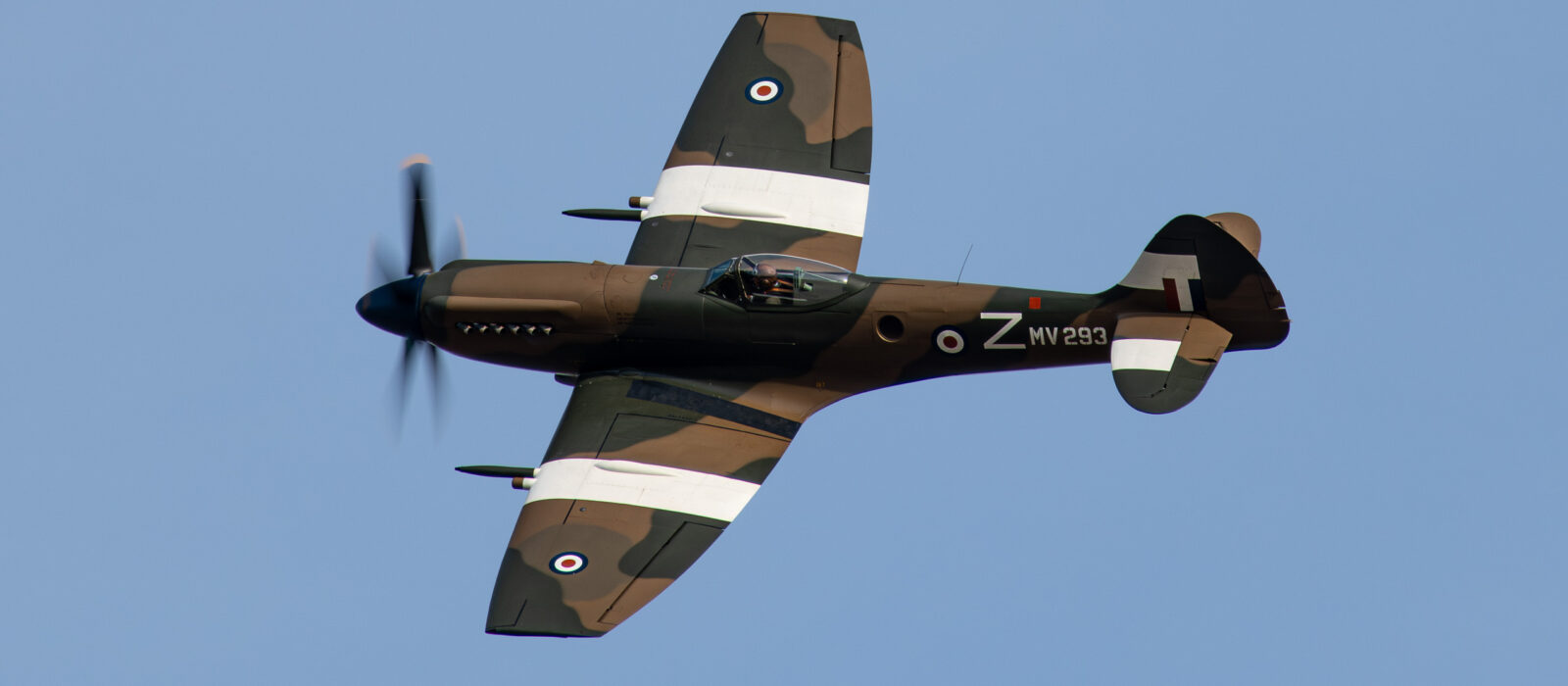
The Supermarine Spitfire FR.XIVe G-SPIT is a striking example of the late-war Spitfire, combining the familiar elegance of the original design with the formidable power of the Rolls-Royce Griffon engine. Built by Vickers-Armstrong at Keevil towards the end of 1944, this aircraft carries the RAF serial MV293 and construction number 6S/649205. Unlike the earlier Merlin-powered Spitfires, the Griffon-powered Mk XIV was designed to deliver a substantial increase in performance, making it one of the fastest and most capable piston-engine fighters to see RAF service during the Second World War.
The Mk XIV emerged from the RAF’s need for a fighter able to counter increasingly fast and high-performing German aircraft. Its Griffon 65 engine produced around 2,050 horsepower and drove a distinctive five-bladed propeller. The resulting aircraft had tremendous acceleration and climb performance, although the powerful engine also introduced a pronounced swing on take-off that demanded careful handling from its pilot. The FR.XIVe reconnaissance fighter featured camera equipment for tactical reconnaissance, alongside the revised “e” wing armament arrangement of two 20 mm Hispano cannon and two .50-calibre Browning machine guns.
MV293’s own story took it far from the skies over wartime Britain. After entering RAF storage in February 1945, it was prepared for overseas shipment and sent to India later that year. By December 1947, it had entered Indian Air Force service, carrying the number 48 and code letter “Z”. It subsequently served as an instructional airframe, designated T.20, at the Indian Air Force Technical College at Jalahalli. This post-war chapter helped preserve an aircraft that might otherwise have disappeared with the many surplus Spitfires scrapped after the war.
In 1978, the airframe was recovered and returned to Britain by Warbirds of Great Britain. Registered initially as G-BGHB and subsequently as G-SPIT, it underwent an extensive restoration before returning to the air on 14 August 1992 at Duxford. Its restoration brought a rare Griffon-powered reconnaissance Spitfire back to flying condition, and it became a familiar sight on the European warbird circuit.
For many years, G-SPIT was particularly recognisable in the markings of MV268, coded JE-J, associated with Wing Commander James Edgar “Johnnie” Johnson, the RAF’s highest-scoring Western Allied fighter ace. In December 2023, the aircraft was repainted in a scheme reflecting its Indian Air Force service, reconnecting its appearance with the remarkable second life it enjoyed after the war. Recent airshow profiles have listed it operating from Sywell under Fighter Aviation Engineering Ltd.