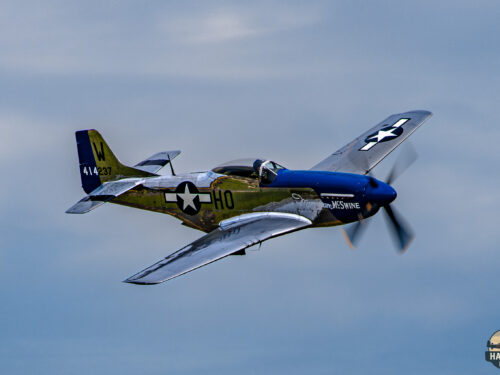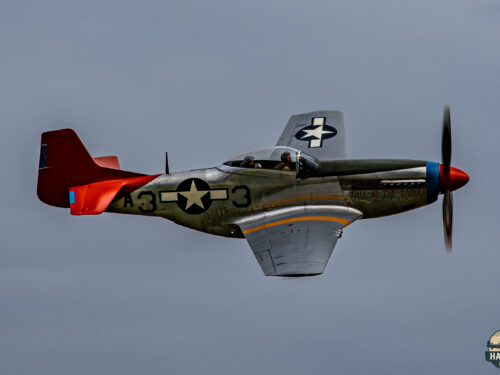
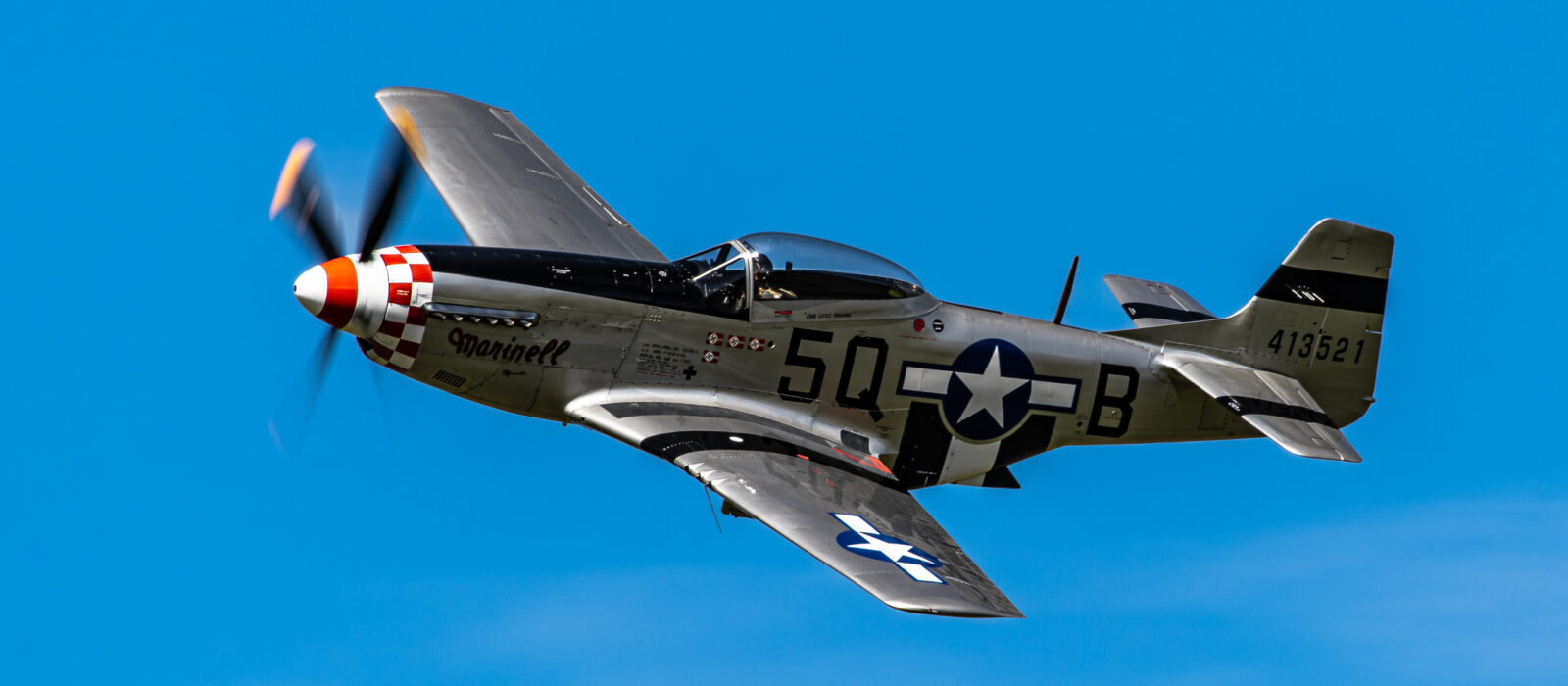
Few aircraft capture the spirit of the Allied air offensive in 1944 quite like the North American P-51D Mustang. Its long, elegant nose, distinctive bubble canopy and powerful Rolls-Royce-designed Merlin engine made it one of the most successful long-range fighters of the Second World War. But behind the polished metal and striking chequered nose of “Marinell” lies a much more personal story: a young American pilot, a Mustang lost over occupied France, and an extraordinary restoration that brought the aircraft back to life more than six decades later.
Built by North American Aviation at its Inglewood, California, factory, Marinell was a P-51D-5-NA carrying USAAF serial 44-13521 and construction number 109-27154. She was shipped to Britain on D-Day, 6 June 1944, and taken on charge by the 504th Fighter Squadron, part of the 339th Fighter Group of the US Eighth Air Force, at RAF Fowlmere in Cambridgeshire. Her squadron code was 5Q-B. Captain Bradford V. Stevens, who was associated with the aircraft, named her Marinell after Mary Anella Stokes, a young woman he had met during his training in the United States.
The 339th Fighter Group was part of the vast American air campaign against Nazi Germany. By the summer of 1944, Mustangs were escorting heavy bombers deep into enemy territory, helping reduce the threat from German fighters and allowing the strategic bombing campaign to reach targets far beyond the range of earlier escort aircraft. As Allied armies advanced after D-Day, P-51s also undertook ground-attack missions against railway lines, transport and other targets supporting German forces. Marinell’s short operational career took place during this intense period of the air war.
On 13 August 1944, Marinell flew a mission over France with Captain Stevens earlier in the day. Later, the aircraft was assigned to Second Lieutenant Myer Rolnick Winkelman for a dive-bombing and area-sweep mission. During the attack, Marinell was lost near Saint-Just-en-Chaussée, north-east of Beauvais. Reports differ in their precise description of the final moments, but accounts indicate that the aircraft was struck by the blast of a bomb dropped by another Allied aircraft before crashing. Winkelman was killed. The loss of Marinell and her pilot was a stark reminder that even during operations against the enemy, low-level attacks and bombing runs could be dangerous for friendly aircraft as well as ground forces.
Marinell had been with the 504th Fighter Squadron for only a short time. The aircraft’s markings today commemorate the victories credited to her wartime identity, although the precise relationship between the aircraft’s tally and Captain Stevens’s personal combat record is not entirely consistent across historical accounts. What is certain is that the Mustang was lost in combat operations in northern France, and that its wreckage survived for decades. The remains were eventually recovered from France and remained stored for many years before British warbird restorer Maurice Hammond acquired them in 1998.
The restoration was a major undertaking, requiring four years of work and the skills of specialists on both sides of the Atlantic. Many original internal components were retained, while major structural work was carried out to return the Mustang to flying condition. Its wings, flaps and ailerons were rebuilt by Odegaard Wings in North Dakota, and a Packard-built Merlin engine was sourced and overhauled. Marinell finally flew again on 26 July 2008, more than 64 years after her wartime loss. The restoration was a remarkable achievement, bringing an aircraft with a genuine combat history back into the air rather than creating a replica from scratch.
After appearing at airshows in Britain, Marinell was sold in 2016 and moved to Italy, where she was registered as I-COLT. She later carried the American registration N383FJ before returning to the United Kingdom in 2023. Now registered G-MRLL, the Mustang is based at Biggin Hill and maintained by the Aircraft Restoration Company on behalf of Marinell Ltd. This return brought her back close to RAF Fowlmere, the airfield from which she had flown on operations in 1944.
The P-51D was powered by the Packard-built Rolls-Royce Merlin V-1650-7, producing around 1,490 horsepower. Its laminar-flow wing, external drop tanks and efficient aerodynamics gave it the range needed to escort bombers deep into Germany and return to Britain. Armed with six .50-calibre Browning machine guns, the Mustang could engage enemy fighters and attack ground targets. Its combination of range, speed and manoeuvrability helped change the balance of the air war over Europe during 1944 and 1945.
Today, Marinell is far more than a beautifully restored Mustang. Her story connects the people who flew and maintained the aircraft in wartime with the modern engineers and pilots who have preserved her for future generations. When she takes to the skies above Duxford, the aircraft’s gleaming finish and unmistakable Merlin sound evoke the summer of 1944 — while remembering Lieutenant Winkelman, who did not return from the mission that ended Marinell’s original flying career.