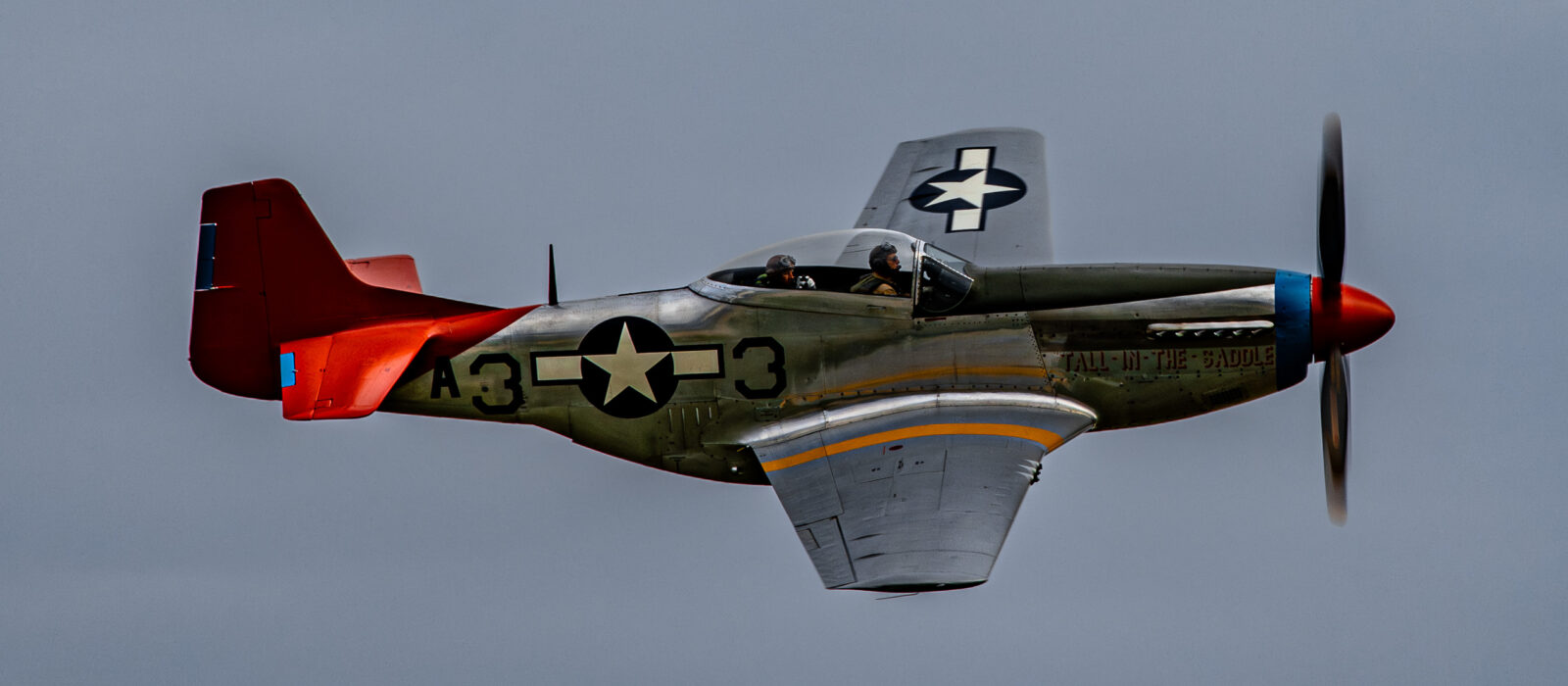
With its polished aluminium finish, vivid red tail and unmistakable Mustang silhouette, “Tall in the Saddle” is more than a spectacular warbird — it is a flying tribute to the Tuskegee Airmen, the pioneering African American pilots who fought prejudice at home while flying combat missions over Europe during the Second World War. This P-51D is particularly significant because it is associated with Lieutenant Colonel George Hardy, one of the Tuskegee Airmen who flew combat missions in the aircraft represented by its markings. Its story connects an original wartime Mustang with one of the most important chapters in American military aviation history.
Built by North American Aviation at Inglewood, California, the aircraft carries USAAF serial 44-72035 and construction number 122-31894. It was accepted on 21 December 1944 and initially prepared for service with the USAAF in the Mediterranean theatre. After crossing the United States by air, it departed for overseas service by ship in January 1945. It reached the European war in its final months, serving in Italy with the Fifteenth Air Force. The aircraft’s original combat identity was A3-3, and its history places it within the wider campaign of long-range fighter escort and ground-attack operations over occupied Europe.
The Mustang became one of the most effective Allied fighters of the war because it combined high speed, manoeuvrability and exceptional range. Powered by a Packard-built Rolls-Royce Merlin V-1650 engine, the P-51D could escort heavy bombers deep into German territory and remain with them through the most dangerous parts of their missions. Its six .50-calibre Browning machine guns gave it formidable firepower, while its bubble canopy offered pilots excellent visibility. By 1944, the Mustang was helping the Allies establish air superiority over Europe, reducing the threat posed by German interceptors and enabling the strategic bombing campaign to continue with greater effectiveness.
The aircraft’s present markings honour George Hardy, who served with the 99th Fighter Squadron, part of the 332nd Fighter Group. The group became famous as the “Red Tails” because of the distinctive red paint applied to its aircraft. The Tuskegee Airmen were the first African American military aviators in the US armed forces, trained at Tuskegee Army Air Field in Alabama. They faced institutional racism and segregation throughout their careers, yet went on to fly hundreds of escort and combat missions. Their achievements helped challenge discriminatory assumptions about African American servicemen and became an enduring part of the story of desegregation in the US military.
Hardy flew combat missions in the Second World War and later returned to the aircraft represented by these markings in a remarkable reunion. In October 2016, at the age of 91, he joined the Mustang for a flight at RAF Lakenheath, revisiting the aircraft and the era that had shaped his life. The reunion was especially poignant because the real wartime aircraft he had flown was long gone, but this surviving Mustang carried its identity forward. Hardy’s presence gave the aircraft a direct human connection to the Tuskegee Airmen, turning a beautifully restored fighter into a powerful memorial to their service and determination.
After the war, 44-72035 returned to the United States and served with Air National Guard units, including a period in which it was used as a target tug. It was eventually sold into civilian ownership and spent time in Colombia before returning to Europe in the late 1980s. For many years it flew in the colourful markings of “Jumpin’ Jacques”, a different Mustang identity, and became a familiar sight at European airshows. It was acquired by Peter Teichman and joined the Hangar 11 collection at North Weald in 2002. In 2016, the aircraft was repainted as “Tall in the Saddle”, restoring the wartime identity associated with George Hardy.
One of the most remarkable aspects of this Mustang is its originality. According to the Aircraft Restoration Company, it has never undergone a complete rebuild, retaining much of its original structure and even evidence of its long operational life. Its return to the “Tall in the Saddle” scheme was therefore not simply a cosmetic choice: it gave a highly original aircraft a historically meaningful identity. In September 2025, it was purchased by Robert Tyrrell, who entrusted the Aircraft Restoration Company at Duxford with its operation. The aircraft is also used for passenger experiences through Aerial Collective, allowing people to experience the Mustang from the air.
Today, G-SIJJ remains one of the most distinctive P-51Ds flying in Britain. The polished finish, red tail and “A3-3” markings recall the wartime Mustang and the men who flew it, while the aircraft’s continuing flight preserves a connection that could otherwise be lost to photographs and written accounts. When “Tall in the Saddle” takes to the skies, it celebrates not only the engineering achievement of the P-51 Mustang, but also the courage of the Tuskegee Airmen — whose legacy extends far beyond the airfields of wartime Italy.